 By
ByIf you’re researching authentic shilajit, you’ve probably come across the word ozokerite. Some people claim it’s another name for shilajit, while others say it’s used to make fake shilajit products. Both statements create confusion, especially if you’re trying to buy a genuine supplement.
The short answer is simple: ozokerite and shilajit are completely different natural substances. They may look similar because both are dark and resin-like, but they come from different geological processes, have different chemical compositions, and serve entirely different purposes.
Shilajit is a mineral-rich substance traditionally used in Ayurvedic medicine and studied for its unique bioactive compounds, including fulvic acid and dibenzo-alpha-pyrones. Ozokerite, on the other hand, is a naturally occurring mineral wax composed primarily of hydrocarbons. It has valuable industrial and cosmetic applications but is not considered a nutritional alternative to shilajit.
Understanding this distinction matters because the global demand for shilajit has increased dramatically over the past few years. As demand grows, so does the number of counterfeit or adulterated products. Learning what ozokerite is—and why it should not be confused with authentic shilajit—can help you make a safer and more informed purchasing decision.
Ozokerite vs Shilajit: Quick Comparison
| Feature | Ozokerite | Shilajit |
| Natural origin | Mineral wax | Organic mineral resin |
| Formation | Petroleum deposits | Decomposed mountain vegetation and minerals |
| Primary composition | Hydrocarbon waxes | Fulvic acid, humic substances, minerals, and bioactive compounds |
| Traditional medicinal use | No | Yes |
| Water behavior | Softens or floats | Gradually dissolves after purification |
| Common use | Cosmetics, candles, polishes | Dietary supplement after purification |
| Fulvic acid | Not present | Naturally present |
| Edible as a supplement | No | Only when properly purified and tested |
Why Are Ozokerite and Shilajit Compared?
The comparison usually begins with appearance. Both substances are naturally dark and dense, and can become softer when warmed. Someone unfamiliar with either material might assume they’re related simply because they look alike.
Another reason is the supplement market itself. Authentic Himalayan shilajit is expensive to collect, purify, and laboratory test. Lower-cost materials that resemble resin may be used to imitate its appearance, leading consumers to question whether ingredients like ozokerite are being substituted.
It’s also important to understand that ozokerite is not inherently “fake.” It is a legitimate natural mineral with recognized industrial uses. The problem arises only when a product marketed as pure shilajit contains ingredients that don’t belong there or fails to match the expected chemical profile of authentic purified shilajit.
Rather than relying on rumors or social media demonstrations, it’s better to compare these materials based on how they form, what they’re made of, and how they are identified in laboratory testing.
What Is Ozokerite?
Ozokerite is a naturally occurring mineral wax that forms deep underground in areas containing petroleum deposits. Over millions of years, liquid hydrocarbons migrate through rock formations and gradually solidify into wax-like mineral veins. These deposits are then mined and refined for commercial use.
Although it comes from nature, ozokerite is chemically very different from botanical or plant-derived substances. Its structure is dominated by long-chain hydrocarbons, making it much closer to natural wax than to an organic resin.
Raw ozokerite is typically dark brown, black, or brownish-yellow depending on its mineral content and level of refinement. It has a firm texture at room temperature but softens noticeably when heated.
Because of its stability and melting characteristics, ozokerite has been used in several industries for decades.
Common applications include:
- Lipsticks and cosmetic formulations
- Skin creams and ointments
- Candles
- Polishes
- Protective coatings
- Electrical insulation
- Specialty wax blends
In cosmetics, ozokerite helps products maintain their shape while creating a smooth texture. In these applications, it functions as a structural ingredient rather than an active health compound.
One common misconception is that because ozokerite is found in cosmetic products, it must also be appropriate for dietary supplements. That assumption is incorrect. The safety standards for topical cosmetic ingredients are different from those for orally consumed supplements.
What Is Shilajit?
Shilajit is a naturally occurring mineral-rich substance that slowly seeps from mountain rocks in high-altitude regions such as the Himalayas, Altai Mountains, Caucasus, and parts of Central Asia. Unlike tree resin, it does not come directly from a single plant. Instead, it forms through an extremely slow biological and geological process.
For centuries, mountain vegetation, mosses, lichens, and other organic matter become trapped within rock layers. Microorganisms gradually break down this plant material while pressure, changing temperatures, and mineral-rich water continue transforming it over hundreds or even thousands of years.
The result is a complex natural substance containing hundreds of organic and inorganic compounds.
This long formation process explains why authentic shilajit has a far more complex chemical profile than substances such as ozokerite. Instead of being primarily composed of hydrocarbons, purified shilajit contains naturally occurring humic substances along with numerous trace minerals and other biologically active molecules.
Modern laboratory analysis commonly identifies compounds such as:
- Fulvic acid
- Humic acid
- Dibenzo-alpha-pyrones
- Trace minerals
- Amino acids
- Phenolic compounds
- Organic acids
Not every sample contains identical concentrations because geography, altitude, surrounding vegetation, and purification methods all influence the final composition.
This natural variability is one reason reputable manufacturers perform laboratory testing on every production batch instead of assuming all shilajit is chemically identical.
Why Fulvic Acid Matters
One of the most discussed compounds in shilajit is fulvic acid. It’s often mentioned on supplement labels, but many consumers don’t understand why it’s important.
Fulvic acid belongs to a group of natural compounds known as humic substances. These molecules develop during the gradual decomposition of plant material in soil and mountain ecosystems. They are not added during manufacturing—they are part of the natural maturation process that produces authentic shilajit.
Researchers have studied fulvic acid because of its antioxidant properties and its potential role in transporting minerals and other compounds. However, it’s important to understand that the overall activity of shilajit cannot be attributed to fulvic acid alone. Scientists believe the interaction between multiple naturally occurring compounds likely contributes to its traditional use.
This is another major distinction between shilajit and ozokerite. Since ozokerite is composed primarily of hydrocarbons rather than decomposed organic matter, it does not naturally contain fulvic acid or other humic substances.
Ozokerite vs Shilajit: The Biggest Differences
Although both materials can appear similar at first glance, nearly every important characteristic differs once you look beyond their appearance.
Origin
Ozokerite originates from petroleum-bearing geological formations. Shilajit develops through the gradual transformation of ancient mountain vegetation combined with mineral-rich rock environments.
Chemical Composition
Ozokerite is primarily made of hydrocarbon waxes.
Shilajit contains a diverse mixture of humic substances, fulvic acid, minerals, organic acids, and naturally occurring bioactive compounds.
Traditional Use
Ozokerite has historically been valued as an industrial mineral.
Shilajit has been used for centuries in traditional Ayurvedic medicine and continues to be researched as a dietary supplement.
Biological Activity
Current scientific interest in shilajit focuses on its naturally occurring compounds and their potential physiological effects. Ozokerite is valued for its physical properties such as texture, stability, and melting behavior, rather than biological activity.
Manufacturing
Commercial ozokerite typically undergoes refining to improve consistency for industrial use.
Authentic shilajit undergoes purification to remove sand, rock fragments, heavy metals, and microbial contaminants while preserving its naturally occurring compounds.
These differences explain why the two materials should never be considered interchangeable, even if they occasionally resemble one another visually.
Can Ozokerite Be Used as Fake Shilajit?
This is one of the most common questions consumers ask, and the answer requires some slightly difference.
Ozokerite itself is not marketed as shilajit. However, because it shares a dark color and waxy appearance, some people worry it could be used as an adulterant in counterfeit products.
Appearance alone cannot confirm whether a supplement contains ozokerite. A black, sticky resin may be authentic shilajit, an entirely different resin, or an adulterated mixture. Visual inspection simply isn’t reliable enough.
This is why laboratories don’t authenticate shilajit based on color, texture, or home experiments. Instead, they analyze its chemical fingerprint to determine whether the expected compounds are present and whether unexpected contaminants or substitute materials exist.
Consumers should be cautious of products that rely on dramatic marketing claims but provide no Certificate of Analysis, no heavy metal testing, and no information about purification or independent laboratory verification.
Choosing a reputable manufacturer that publishes transparent testing data is a much more reliable approach than trying to identify authenticity through appearance alone.
Ozokerite vs Shilajit at the Chemical Level
The biggest difference between ozokerite and shilajit isn’t how they look—it’s what they’re made of. From a chemistry perspective, these substances belong to completely different categories.
Ozokerite is primarily composed of long-chain saturated hydrocarbons. These molecules are chemically similar to other naturally occurring mineral waxes and are valued because they remain stable over a wide range of temperatures. This stability makes ozokerite useful in cosmetics, candles, and industrial products.
Shilajit has a far more complex chemical profile. Instead of being dominated by hydrocarbons, it contains hundreds of naturally occurring organic and inorganic compounds created during the decomposition of ancient mountain vegetation. Researchers commonly identify fulvic acid, humic substances, dibenzo-alpha-pyrones, trace minerals, amino acids, and other naturally occurring molecules.
This difference explains why authentic shilajit is studied as a dietary supplement, while ozokerite is primarily valued as an industrial material.
| Characteristic | Ozokerite | Shilajit |
| Main composition | Hydrocarbon waxes | Humic substances and minerals |
| Fulvic acid | Not naturally present | Naturally present |
| Humic acid | Not present | Present |
| Trace minerals | Very limited | Naturally abundant |
| Organic acids | Minimal | Multiple naturally occurring acids |
| Primary use | Industrial and cosmetic | Purified dietary supplement |
| Chemical complexity | Relatively simple | Highly complex natural matrix |
How Ozokerite and Shilajit Form
Understanding how these materials form makes their differences much easier to understand.
How Ozokerite Forms
Ozokerite begins deep underground in petroleum-bearing rock formations. Over millions of years, liquid hydrocarbons migrate through cracks in the surrounding rock. As temperature and pressure change, these hydrocarbons solidify into naturally occurring mineral wax deposits.
Mining companies extract these deposits before refining them for commercial use.
Its formation is entirely geological and driven by petroleum chemistry rather than biological activity.
How Shilajit Forms
Shilajit follows a completely different path.
High-altitude plants, mosses, lichens, and other organic material become trapped within mountain rocks. Over centuries, microorganisms gradually break this material down while minerals from surrounding rocks mix into the organic matter.
Seasonal temperature changes slowly force this mineral-rich substance toward the rock surface, where it eventually appears as a dark resin.
This biological transformation explains why shilajit naturally contains compounds associated with decomposed plant matter instead of petroleum-derived hydrocarbons.
Appearance: Why They Can Look Similar
Many consumers assume two dark substances must be closely related, but appearance can be misleading.
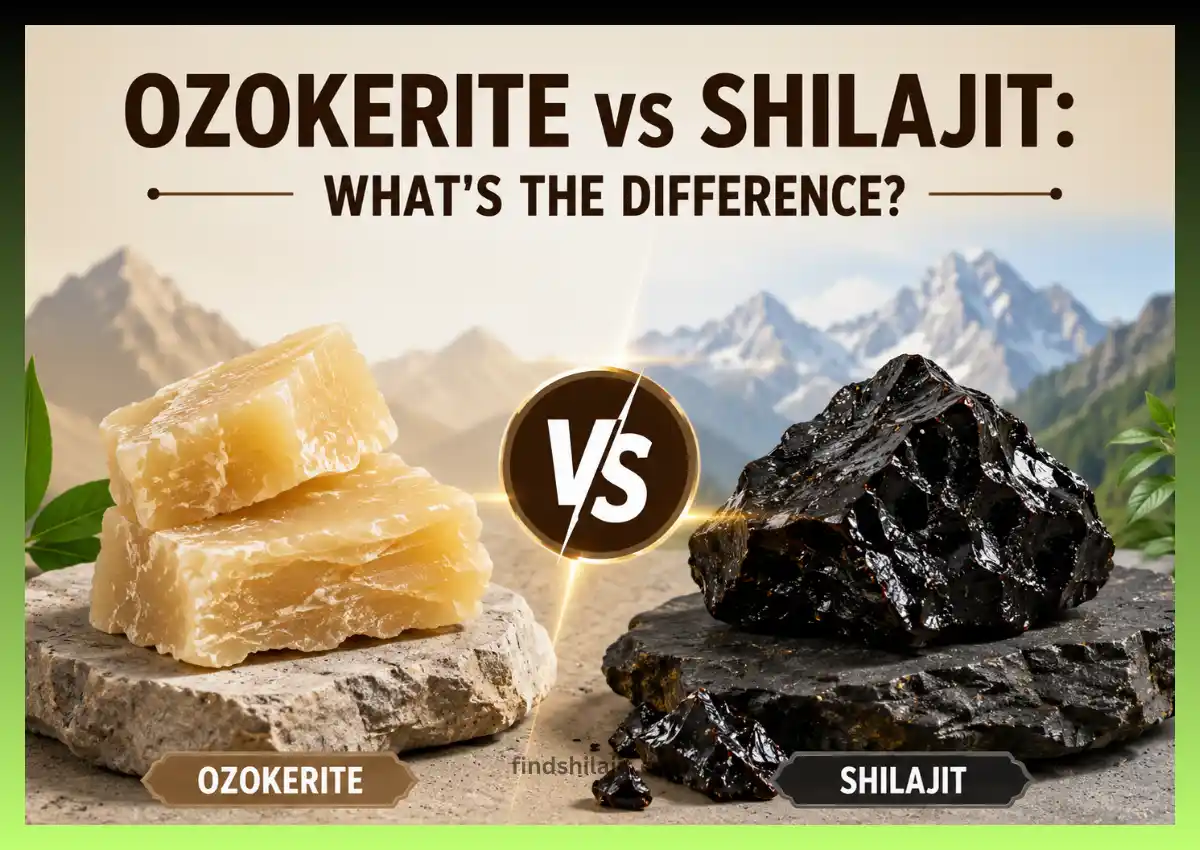
Raw ozokerite usually has a waxy texture with a slight shine. Depending on purity, it may appear black, dark brown, or brownish-yellow. When warmed, it softens much like other natural waxes.
Purified shilajit is typically dark brown to black and becomes softer when exposed to body heat. High-quality resin often has a glossy appearance and can be stretched slightly between the fingers when warm.
Although both may appear similar in photographs, experienced laboratories never rely on appearance for identification because many natural substances can share similar colors and textures.
Does Ozokerite Dissolve in Water Like Shilajit?
The water test is one of the most popular home methods promoted online, but it’s also one of the most misunderstood.
Authentic purified shilajit generally softens and gradually disperses in warm water, producing a brown or amber-colored solution. Depending on the purification method, a small amount of insoluble mineral residue may remain.
Ozokerite behaves differently because hydrocarbons are naturally water resistant. Instead of dissolving, it tends to remain intact, soften with heat, or float due to its waxy composition.
However, this difference should not be treated as a definitive authenticity test.
Manufacturing techniques, added ingredients, fillers, and purification methods can all influence how a product behaves in water. A counterfeit product can be designed to mimic expected behavior, while genuine products from different manufacturers may not dissolve identically.
For that reason, reputable laboratories do not rely on water tests when verifying shilajit.
Can Home Tests Identify Fake Shilajit?
Many websites recommend simple tests using water, fire, alcohol, or even refrigeration. While these demonstrations attract attention on social media, they have important limitations.
A home test cannot identify:
- Fulvic acid concentration
- Heavy metal contamination
- Hydrocarbon contamination
- Microbial safety
- Mineral profile
- Chemical adulteration
For example, heating a sample may tell you whether it softens, but it cannot determine what compounds are actually present.
Likewise, observing how quickly a sample dissolves in water provides very little information about whether it has been purified correctly or whether unwanted materials have been added.
These demonstrations can occasionally reveal obvious quality problems, but they should never replace professional laboratory analysis.
How Laboratories Detect Ozokerite in Shilajit
When scientists want to verify whether a shilajit sample is authentic, they examine its chemical fingerprint rather than its appearance.
Different analytical techniques reveal different parts of the sample’s composition.
Fourier Transform Infrared Spectroscopy (FTIR)
FTIR identifies specific chemical bonds within a sample.
Hydrocarbon waxes produce characteristic absorption patterns that differ significantly from the humic substances naturally found in shilajit.
If a sample contains unexpected petroleum-derived compounds, FTIR can often detect them.
Gas Chromatography-Mass Spectrometry (GC-MS)
GC-MS separates individual molecules before identifying them based on their molecular structure.
This method is particularly useful for detecting hydrocarbon compounds that should not be present in authentic purified shilajit.
High-Performance Liquid Chromatography (HPLC)
HPLC helps quantify naturally occurring compounds such as fulvic acid and other organic molecules.
Rather than simply asking whether fulvic acid exists, laboratories can estimate its concentration and compare it with expected ranges.
ICP-MS Mineral Analysis
Inductively Coupled Plasma Mass Spectrometry (ICP-MS) measures trace minerals and screens for potentially harmful heavy metals.
Since shilajit naturally accumulates minerals from mountain environments, testing for lead, mercury, arsenic, and cadmium is an essential part of quality control.
Microbiological Testing
Purification should also remove harmful microorganisms.
Laboratories routinely test for:
- Salmonella
- E. coli
- Yeast
- Mold
- Total microbial count
These safety tests are just as important as chemical analysis.
Why Third-Party Testing Matters
Not every company claiming to sell authentic shilajit performs comprehensive laboratory testing.
Some manufacturers only test one production batch and continue using those results for months or years. Others provide no documentation at all.
Independent third-party testing increases transparency because an external laboratory—not the manufacturer—evaluates the product.
When buying shilajit, look for brands that provide a recent Certificate of Analysis (COA) showing:
- Heavy metal testing
- Microbial testing
- Mineral profile
- Fulvic acid analysis when available
- Batch number
- Testing laboratory
- Testing date
These reports provide much stronger evidence of quality than marketing claims or social media videos.
How to Tell Whether Your Shilajit Might Be Low Quality
No single characteristic can confirm authenticity, but several warning signs deserve attention.
Be cautious if a product:
- Doesn’t identify where the shilajit was sourced.
- Provides no laboratory reports.
- Makes unrealistic health claims.
- Lists vague ingredients without explaining purification.
- Is dramatically cheaper than comparable tested products.
- Has an unusually strong petroleum or chemical odor.
These factors don’t automatically prove a product contains ozokerite, but they suggest the manufacturer may not be following the level of transparency expected for a premium dietary supplement.
The most reliable way to evaluate any shilajit product is still the same: review independent laboratory testing instead of relying on appearance, smell, or simple home experiments.
Is Ozokerite Safe to Eat?
This is one of the most important questions consumers ask after learning that ozokerite is a naturally occurring mineral.
The answer is straightforward: ozokerite is not used as a dietary supplement and should not be considered a replacement for purified shilajit.
Although ozokerite has a long history of use in cosmetics, ointments, and industrial products, those applications involve different safety standards than products intended for oral consumption.
Its value comes from its physical properties, such as stability, texture, and melting behavior—not from nutritional or bioactive compounds.
If you’re purchasing a supplement advertised as pure shilajit, the product should contain purified shilajit rather than petroleum-derived mineral waxes or unidentified fillers.
Why Authentic Shilajit Contains Fulvic Acid but Ozokerite Doesn’t
Many supplement labels highlight fulvic acid, but the reason goes back to how shilajit forms.
Shilajit begins as mountain vegetation that slowly decomposes through microbial activity. During this natural process, complex organic molecules called humic substances develop. Fulvic acid is one component of this larger family.
These compounds are created over long periods as organic matter breaks down and interacts with minerals in the surrounding environment.
Ozokerite forms in an entirely different way. It originates from petroleum deposits rather than decomposed plant material. Since hydrocarbons don’t undergo the same biological transformation, ozokerite doesn’t naturally contain fulvic acid or other humic substances found in authentic shilajit.
This difference is one of the clearest chemical distinctions between the two materials.
How to Buy Authentic Shilajit
Because appearance alone cannot confirm authenticity, choosing the right manufacturer is far more important than performing home tests.
When evaluating a product, look for brands that clearly explain:
- Where the shilajit was sourced.
- How it was purified.
- Whether every batch undergoes independent laboratory testing.
- Whether heavy metals and microbial contaminants were screened.
- Whether a recent Certificate of Analysis (COA) is available.
Transparent companies are usually willing to share this information because laboratory verification is an important part of quality control.
If a manufacturer refuses to discuss testing or cannot provide documentation, consumers have very little objective evidence about what’s actually inside the product.
Red Flags to Watch For
Not every poor-quality product contains ozokerite, but several warning signs should make you more cautious.
Avoid products that:
- Promise instant or miraculous health results.
- Claim to cure diseases.
- Don’t mention purification.
- Provide no batch-specific laboratory testing.
- Hide the ingredient source.
- Sell at prices that seem unrealistically low.
- Offer only social media demonstrations instead of laboratory reports.
Quality supplements are usually backed by transparency rather than exaggerated marketing.
Common Myths About Ozokerite and Shilajit
Myth: Ozokerite is another name for shilajit.
No. They are separate natural materials with different geological origins and different chemical compositions.
Myth: Both contain fulvic acid.
Only authentic shilajit naturally contains fulvic acid because it forms from decomposed organic matter.
Myth: If it looks black, it’s probably shilajit.
Many natural and manufactured materials are dark in color. Appearance alone cannot identify authentic shilajit.
Myth: Water tests prove authenticity.
Water tests may show how a sample behaves, but they cannot determine chemical composition, purity, heavy metal content, or contamination.
Myth: All shilajit products are identical.
Natural shilajit varies depending on its source, purification process, and manufacturing standards. That’s why laboratory testing is so important.
Frequently Asked Questions
Is ozokerite the same as shilajit?
No. Ozokerite is a naturally occurring mineral wax, while shilajit is a mineral-rich organic substance formed from ancient mountain vegetation and minerals.
Is ozokerite used to make fake shilajit?
There is concern that materials with a similar appearance could be used in counterfeit products, but appearance alone cannot confirm adulteration. Only laboratory testing can determine whether a product contains unexpected substances.
Does authentic shilajit contain petroleum?
Authentic purified shilajit should have a chemical profile consistent with naturally occurring humic substances and minerals rather than petroleum-derived waxes.
Can laboratories detect ozokerite?
Yes. Analytical methods such as FTIR, GC-MS, and other chemical techniques can identify hydrocarbon compounds that differ from the expected composition of authentic shilajit.
Does all shilajit dissolve completely in water?
Not necessarily. Purification methods, mineral content, and product formulation can influence how quickly a sample disperses. Water behavior alone should never be used to judge authenticity.
Why do reputable brands perform heavy metal testing?
Because shilajit is collected from mountain environments where minerals naturally accumulate. Independent testing helps verify that potentially harmful heavy metals remain within accepted safety limits.
What should I look for before buying shilajit?
Choose products that provide:
- Independent third-party testing
- Recent Certificate of Analysis
- Heavy metal screening
- Microbial testing
- Transparent sourcing
- Clear purification information
These factors are much more meaningful than marketing claims or viral authenticity tests.
Final Verdict: Ozokerite vs Shilajit
Although ozokerite and shilajit may appear similar at first glance, they are fundamentally different substances.
Ozokerite is a naturally occurring mineral wax formed from petroleum deposits. Its strength lies in industrial and cosmetic applications where stability and texture are important.
Shilajit is a mineral-rich organic substance formed through the gradual decomposition of mountain vegetation over long periods. Its naturally occurring fulvic acid, humic substances, trace minerals, and other bioactive compounds have made it an important part of traditional Ayurvedic medicine and the focus of ongoing scientific research.
For consumers, the most important takeaway is simple: don’t judge shilajit by its appearance.
A dark, sticky resin tells you very little about what’s actually inside the product. Instead, choose brands that invest in purification, publish independent laboratory testing, and provide batch-specific Certificates of Analysis. Those quality measures offer far more confidence than any home authenticity test and help ensure you’re purchasing genuine, properly tested shilajit rather than an unknown substitute.
Also Read:
Ginseng vs Shilajit: Which Adaptogen Is Better?
Shilajit vs Alcohol: What Happens Inside Your Body?
References
- Shilajit: A Natural Phytocomplex with Potential Procognitive Activity
- Shilajit: A Panacea for High-Altitude Problems
- NIH Office of Dietary Supplements
- U.S. FDA – Dietary Supplements
- United States Pharmacopeia (USP)
- AOAC INTERNATIONAL
- Encyclopaedia Britannica – Ozokerite
- PubChem
Disclaimer
This article is for informational purposes only. Please consult a licensed healthcare provider before starting any new supplement, especially if you are pregnant, breastfeeding, or on medication.

Reviewed by: Dr. Natha Thomas, PhD (USA)
Nutrition and supplement research professional interested in nutritional science, dietary supplements, nutrient bioavailability, scientific literature, and how research findings are communicated to consumers.
View full profile →Medical review date: July 19, 2026