 By
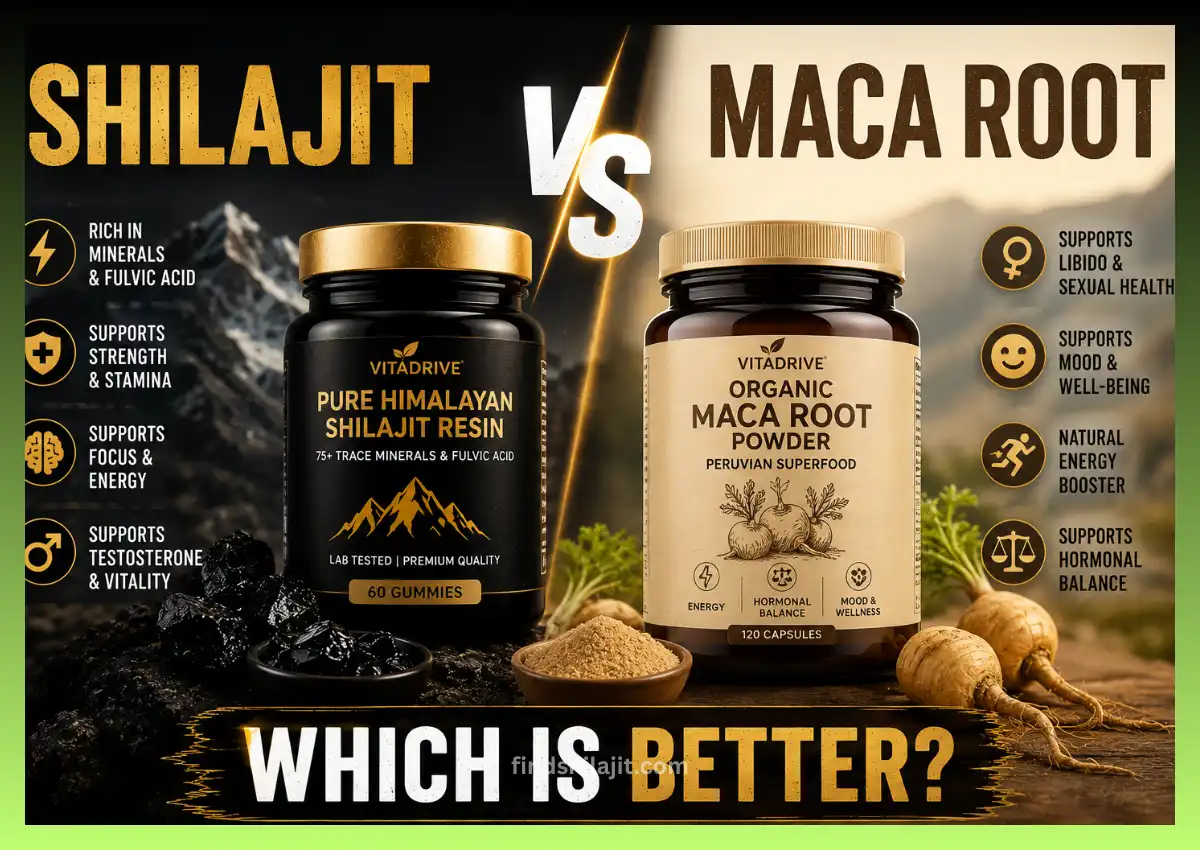
ByAre you confused about Shilajit vs Maca Root: Which one to choose?
Quick answer: they’re not competing for the same job. Shilajit has actual clinical evidence tied to testosterone.
Maca has repeated clinical evidence for improving libido and sexual desire without changing testosterone at all.
If your goal is hormonal support, shilajit has the stronger paper trail. If your goal is libido and mood, maca has the longer track record. Here’s the full breakdown.
What is shilajit?
Shilajit is a mineral-rich resin that oozes out of rock crevices in the Himalayas and a few other high-altitude ranges, formed over centuries from decomposed plant matter. Its main active compound is fulvic acid, alongside dibenzo-alpha-pyrones and 80-plus trace minerals.
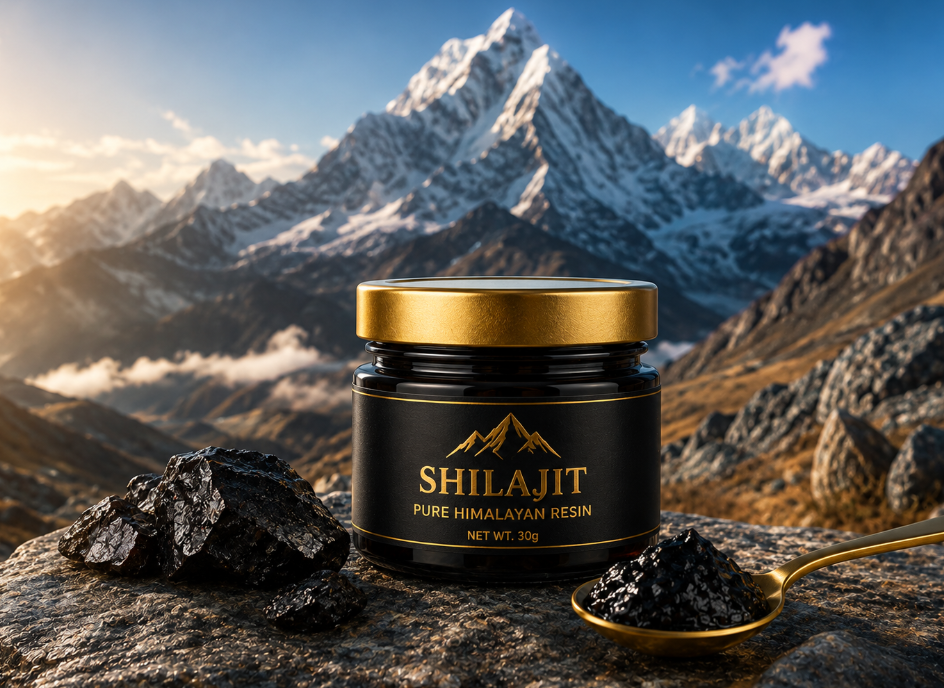
Traditionally, it’s used in Ayurvedic medicine as a rasayana, a rejuvenator taken for general vitality, stamina, and recovery. In modern research, the strongest human evidence points to testosterone support and exercise recovery, both from purified, standardized extracts rather than random Amazon resin.
What is maca root?
Maca (Lepidium meyenii) is a cruciferous root vegetable grown almost nowhere else but the Peruvian Andes, at 4,000 to 4,500 meters elevation. It’s been a food staple there for thousands of years, eaten roasted, boiled, or fermented, and also used traditionally for fertility and stamina.
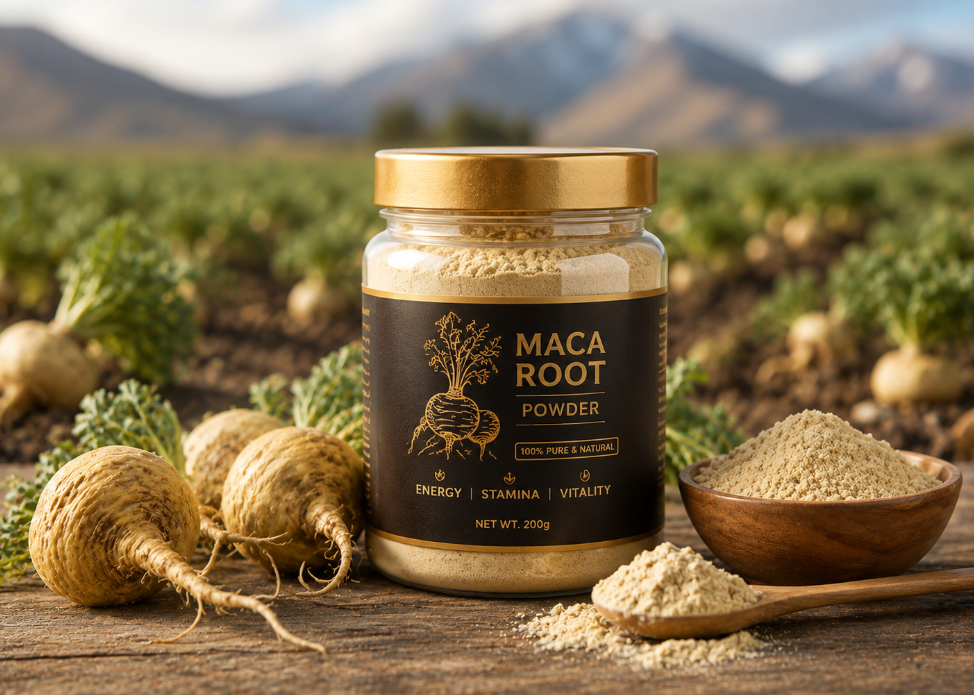
Maca comes in three main colors, and they’re not interchangeable:
- Yellow maca — the most common, mildest, used broadly for energy and general wellness
- Red maca — studied for prostate health and mood/energy support
- Black maca — the variety most studied for sperm count, motility, and male fertility markers, mostly in animal studies
Unlike shilajit, maca isn’t a mineral resin. It’s a food-derived root, sold as powder, capsules, or extract.
Shilajit vs maca root: key differences
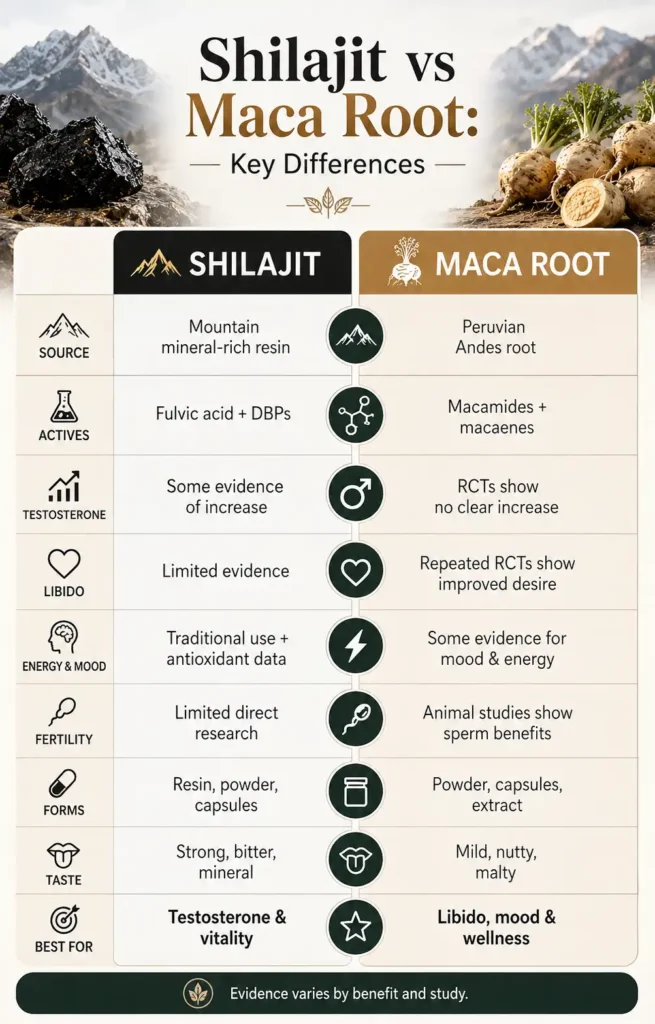
| Factor | Shilajit | Maca Root |
| Source | Mineral-rich resin from mountain rock | Root vegetable from the Peruvian Andes |
| Main active compound | Fulvic acid, dibenzo-alpha-pyrones | Macamides, macaenes, glucosinolates |
| Testosterone evidence | One RCT showed a rise (Pandit et al., 2016) | Multiple RCTs show no change (Gonzales et al., 2002, 2003) |
| Libido evidence | Limited, mostly tied to traditional use | Repeated RCTs show improved sexual desire |
| Energy/mood evidence | Traditional use, some antioxidant data | One RCT (2016) showed improved mood/energy scores |
| Fertility/sperm evidence | Not directly studied | Animal studies (mainly black maca) show sperm count gains |
| Form | Resin, powder, capsules | Powder, capsules, gelatinized extract |
| Taste | Strong, bitter, mineral | Mild, nutty, malty |
| Best for | Men targeting testosterone and general vitality | Libido, mood, and general wellness |
Maca vs shilajit for testosterone
Does shilajit increase testosterone?
The best available evidence says yes, modestly. A 2016 randomized, double-blind, placebo-controlled trial in Andrologia gave 75 healthy men aged 45-55 purified shilajit at 250 mg twice daily for 90 days. Total testosterone rose about 20%, free testosterone about 19%, versus placebo.
Does black maca increase testosterone?
No, and this is one of the most consistently replicated findings in the maca research. A landmark 2002 trial in Andrologia gave men 1,500 mg or 3,000 mg of maca daily for 12 weeks and found no change in serum testosterone or estradiol compared to placebo, despite a measurable improvement in sexual desire. A follow-up 2003 study in the Journal of Endocrinology confirmed the same pattern: maca affects reproductive hormone-adjacent outcomes without moving testosterone itself.
Why does libido improve without testosterone rising?
Researchers believe maca works through a different pathway than androgen stimulation, likely involving mood, energy, and possibly non-steroidal compounds unique to the plant. That’s actually a selling point for some men, since it means maca doesn’t carry the downstream hormonal feedback risks that come with actually elevating testosterone.
Which has stronger evidence?
For testosterone specifically, shilajit. For libido without touching hormone levels, maca has the deeper, more consistent research base.
Black maca vs shilajit
Black maca gets singled out in maca research because it consistently outperforms the yellow and red varieties in animal studies on sperm count and epididymal sperm motility. That evidence is almost entirely from rat studies; direct human trials on black maca specifically for fertility are still limited.
For energy: Both have supporting data, but it’s not head-to-head. Shilajit’s energy claims lean on antioxidant and mitochondrial support research. Black maca’s energy data comes mostly bundled with red maca in a 2016 human trial on mood, energy, and altitude sickness scores, where red maca actually edged out black maca on mood and energy specifically.
For libido: Maca (in general, not black maca specifically) has the stronger, more repeated human evidence. Shilajit’s libido angle is more inferential, based on traditional use and its testosterone effect rather than a study measuring libido directly.
For testosterone: Shilajit, by a clear margin. Black maca’s strongest evidence is about sperm parameters in animals, not serum testosterone in humans.
Bottom line on this comparison: black maca leans toward fertility-adjacent markers (sperm count, motility) in preclinical research, while shilajit leans toward a direct, human-tested hormonal effect. Different targets, not a straight better-or-worse.
Shilajit and maca together: benefits
Can you take shilajit and maca together? Yes, there’s no known direct interaction between the two, and plenty of commercial “male vitality” blends already combine them with ashwagandha or tongkat ali. That said, no clinical trial has tested the combination specifically, so any claimed synergy is a marketing assumption, not proven data.
Potential combined benefits, based on what each ingredient does on its own:
- Energy and stamina — shilajit’s mineral/antioxidant support plus maca’s mood and energy effect
- Libido — maca’s more direct libido evidence stacked with shilajit’s hormonal angle
- Exercise performance — shilajit’s strength/recovery data (Keller et al., 2019) alongside maca’s fatigue-related findings in animal studies
- Overall vitality — both have centuries of traditional use for general stamina, even where modern trial data is still catching up
Considerations before combining: Maca contains goitrogenic compounds, so people with thyroid conditions should be cautious with it specifically. Shilajit carries its own cautions around iron overload, gout, and autoimmune conditions. Stacking two supplements means stacking two sets of precautions, not just doubling the benefit.
Who should avoid combining them without professional advice: anyone with a thyroid disorder, hemochromatosis or other iron overload condition, gout or elevated uric acid, an active autoimmune condition, or anyone on hormone-affecting medication. Pregnant or breastfeeding women should avoid both without medical clearance.
Shilajit vs maca: what people say on Reddit
Forum discussions on r/Supplements and similar communities tend to follow a pattern that’s worth knowing before you buy based on hype: people report maca as more noticeable for mood and a general sense of drive within a few weeks, while shilajit reports skew toward a slower-building, more subtle energy and recovery effect over a month or more. Black maca specifically gets mentioned by users focused on fertility or libido goals rather than energy.
Take all of this with real caution. Reddit threads aren’t controlled studies, dosages and product quality vary wildly between posters, and placebo effect is impossible to rule out in a comment thread. Use forum experiences to get a feel for what to expect, not as a substitute for the clinical evidence above.
Which is better: shilajit or maca?
- For testosterone: shilajit has the edge, backed by an actual RCT showing a measurable rise.
- For libido: both may help, but maca has the more consistent, repeated human evidence specifically for sexual desire.
- For energy: both have supporting data, though neither has a large, definitive trial.
- For workout performance: shilajit has the more direct data (strength retention, recovery markers); maca’s performance data is thinner and mostly animal-based.
- For general wellness: either is reasonable, and this is where traditional use matters most since the modern clinical picture is still incomplete for both.
FAQs
Is shilajit better than maca?
Depends on the goal. For testosterone, shilajit has better evidence. For libido without affecting hormone levels, maca does.
Can I take shilajit and maca together?
Yes, no known interaction, but check the safety cautions for each ingredient individually first.
Does black maca increase testosterone?
No. Multiple human trials show maca, including black maca, does not raise serum testosterone despite improving subjective libido.
Is maca or shilajit better for libido?
Maca has more repeated, direct human evidence for improved sexual desire. Shilajit’s libido benefit is inferred from its hormonal and traditional-use data rather than directly measured.
Can men take maca and shilajit together?
Yes, commonly done in blended supplements, though always check for the individual contraindications listed above.
How long does shilajit take to work?
Most protocols and clinical trials run 8 to 12 weeks before measuring results; expect gradual changes, not immediate effects.
How long does maca take to work?
Clinical trials on libido and mood effects typically ran 8 to 12 weeks as well, with some users reporting subjective changes in mood or energy sooner.
Final verdict
Shilajit’s strongest case is testosterone and physical performance, with actual clinical trial data behind both. Maca’s strongest case is libido and mood, with a more consistently replicated (and consistently testosterone-neutral) research base.
Taking both is reasonable if you check the individual precautions first and buy from a brand that publishes third-party lab testing, since quality control issues affect both ingredients across the supplement market. If you can only pick one, match it to your actual goal rather than picking whichever has better marketing.
Also Read:
Athanase Vs Shilajit Which Is Better?
Shilajit vs Seamoss Which is better?
Shilajit Extract vs Resin: Which Should You Buy?
Scientific research and resources
- Pandit et al., 2016, Andrologia — clinical trial on purified shilajit and testosterone levels
- Keller et al., 2019, Journal of the International Society of Sports Nutrition — clinical trial on shilajit, muscular strength, and recovery
- Gonzales et al., 2002, Andrologia — RCT on maca, sexual desire, and its lack of effect on serum testosterone
- Gonzales et al., 2006, Andrologia — black maca and spermatogenic cycle effects in rats
- Maca and semen quality, systematic review and meta-analysis, 2022 — pooled data on maca color variants and sperm parameters
- Gasco et al., 2016, red and black maca on mood, energy, and altitude sickness — 12-week human RCT on maca and quality-of-life measures
- Dording et al., 2015, International Journal of Endocrinology — placebo-controlled trial on maca for antidepressant-induced sexual dysfunction
- Shilajit overview, Wikipedia — composition and traditional background
Disclaimer
This article is for informational purposes only and isn’t medical advice. These statements haven’t been evaluated by the FDA. Dietary supplements aren’t intended to diagnose, treat, cure, or prevent any disease. Talk to a licensed healthcare provider before starting any new supplement, especially if you’re pregnant, breastfeeding, taking medication, or managing a health condition. If you experience an adverse reaction, stop use and contact your doctor, or report it to the FDA through MedWatch.

Reviewed by: Dr. Natha Thomas, PhD (USA)
Nutrition and supplement research professional interested in nutritional science, dietary supplements, nutrient bioavailability, scientific literature, and how research findings are communicated to consumers.
View full profile →Medical review date: September 8, 2026