 By
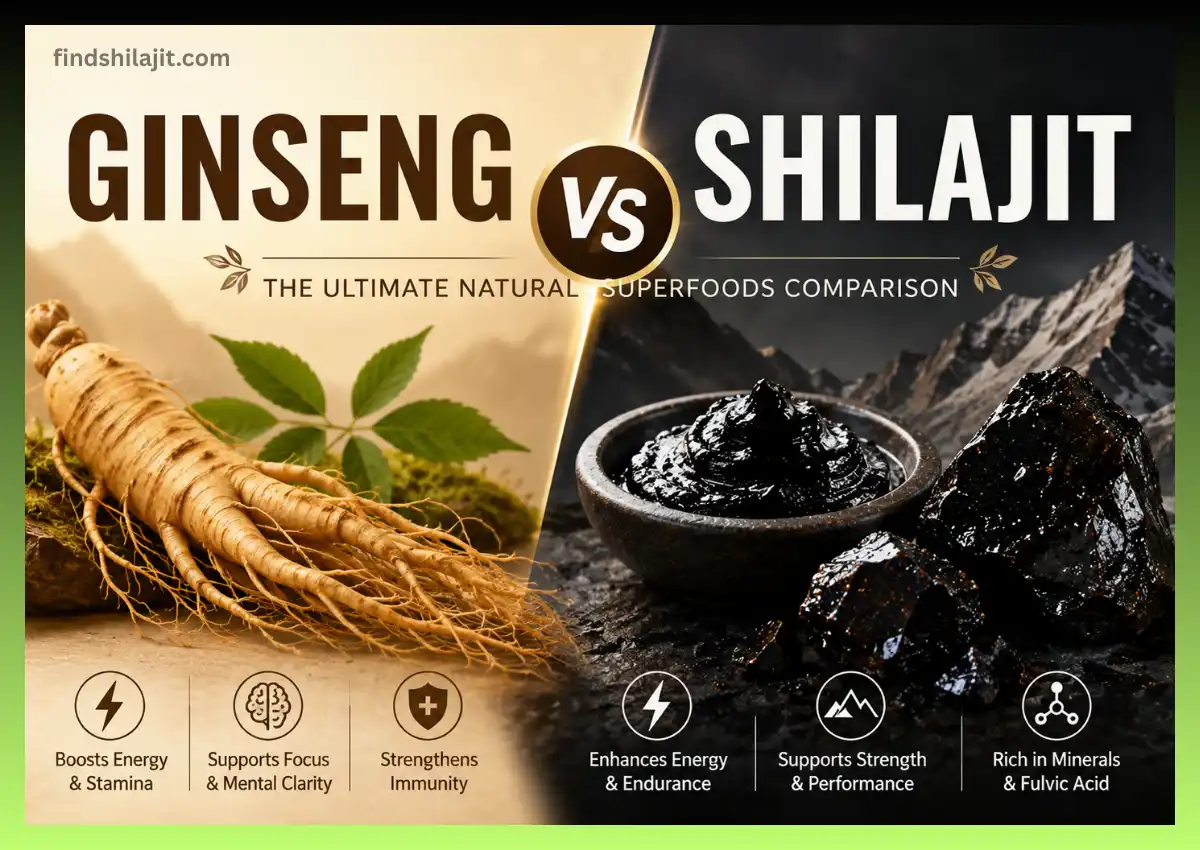
ByGinseng vs Shilajit is one of the most common comparisons among people looking for a natural way to improve energy, reduce fatigue, support recovery, and manage everyday stress. While both are well-known adaptogens, they work differently inside the body. Understanding those differences can help you choose the option that best matches your health goals instead of following marketing claims.
Some people want better focus during busy workdays, while others are looking for sustained stamina, muscle recovery, or long-term vitality. That is why comparing Shilajit and Ginseng side by side is more useful than looking at either supplement in isolation.
In this comprehensive guide, you’ll learn the difference between Shilajit and Ginseng, how each works, who should consider them, whether they can be taken together, and how to choose the right supplement based on scientific evidence rather than advertising.
Quick Answer
Choose Shilajit if your priority is long-term energy, recovery, mineral support, and sustained vitality.
Choose Ginseng if you need short-term mental alertness, concentration, or temporary support during stressful periods.
Depending on your health goals, some healthy adults may also choose to use Ginseng and Shilajit together, provided they follow appropriate serving recommendations and consult a healthcare professional if needed.
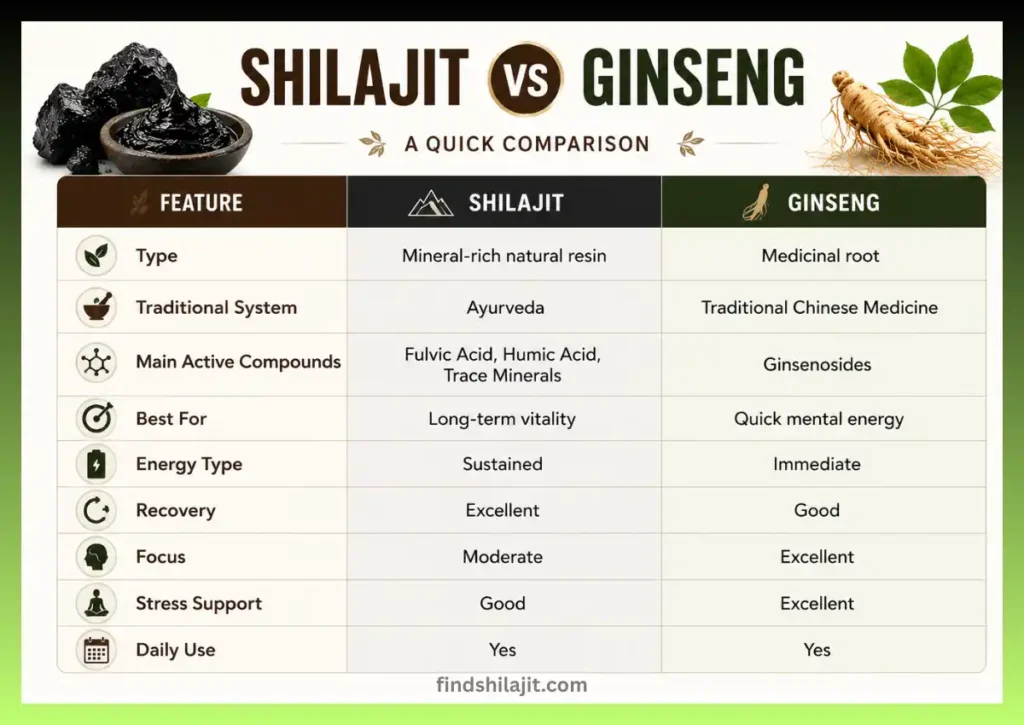
Quick Comparison
| Feature | Shilajit | Ginseng |
| Type | Mineral-rich natural resin | Medicinal root |
| Traditional System | Ayurveda | Traditional Chinese Medicine |
| Main Active Compounds | Fulvic Acid, Humic Acid, Trace Minerals | Ginsenosides |
| Best For | Long-term vitality | Quick mental energy |
| Energy Type | Sustained | Immediate |
| Recovery | Excellent | Good |
| Focus | Moderate | Excellent |
| Stress Support | Good | Excellent |
| Daily Use | Yes | Yes |
At first glance, these supplements may seem similar because both are classified as adaptogens. However, they support the body through different biological pathways.
What Is an Adaptogen?
An adaptogen is a naturally occurring substance that helps the body respond more effectively to physical, mental, and environmental stress.
Unlike stimulants that provide a temporary burst of energy followed by a crash, adaptogens are generally used to support the body’s ability to maintain balance over time.
Common adaptogens include:
- Shilajit
- Panax Ginseng
- Ashwagandha
- Rhodiola Rosea
- Holy Basil
Although these herbs and natural substances belong to the same category, each has unique compounds that influence the body differently.
What Is Shilajit?
Shilajit is a sticky, mineral-rich resin naturally formed over centuries as plant material slowly decomposes under layers of rock in high-altitude mountain regions such as the Himalayas.
For thousands of years, it has been used in Ayurvedic medicine as a rejuvenating substance to support strength, stamina, and overall wellness.
Its most notable naturally occurring compounds include:
- Fulvic Acid
- Humic Acid
- Trace Minerals
- Magnesium
- Zinc
- Iron
- Potassium
Because of this mineral profile, Shilajit is often chosen by people seeking long-term energy rather than immediate stimulation.
What Is Ginseng?
Ginseng is a medicinal root that has been used in Traditional Chinese Medicine for more than 2,000 years.
The two most recognized varieties are:
- Korean (Panax) Ginseng
- American Ginseng
Unlike Shilajit, which is a mineral resin, Ginseng is valued for naturally occurring compounds known as ginsenosides.
These compounds have been widely studied for their potential role in supporting:
- Mental alertness
- Focus
- Physical stamina
- Stress response
Many people choose Ginseng when they need temporary support during demanding work, travel, or study periods.
Ginseng vs Shilajit: What’s the Biggest Difference?
Although both supplements are considered adaptogens, they support the body in different ways.
Shilajit
Shilajit primarily supports:
- Cellular energy production
- Mineral replenishment
- Physical endurance
- Recovery after exercise
- Long-term vitality
Instead of acting as a stimulant, it is generally used as part of a consistent daily wellness routine.
Ginseng
Ginseng is commonly selected for:
- Mental focus
- Temporary fatigue
- Short-term alertness
- Stressful work periods
- Cognitive performance
Some users notice its effects sooner than Shilajit, although individual responses vary.
Difference Between Shilajit and Ginseng
Understanding the difference between Shilajit and Ginseng is easier when you compare their origin, composition, and typical use.
| Feature | Shilajit | Ginseng |
| Natural Source | Mineral resin | Plant root |
| Traditional Medicine | Ayurveda | Traditional Chinese Medicine |
| Main Compounds | Fulvic Acid, Minerals | Ginsenosides |
| Formation | Naturally formed over centuries | Cultivated root |
| Primary Goal | Long-term vitality | Mental alertness |
| Typical Form | Resin, Capsules, Powder | Root, Capsules, Extract |
| Daily Serving | Usually 250–500 mg resin | Depends on extract strength |
| Processing | Purification required | Drying and extraction |
Neither option is universally better. The right choice depends on your health goals, lifestyle, and personal preferences.
How Do They Work Inside the Body?
One reason people compare Ginseng vs Shilajit is because they both support energy—but through completely different mechanisms.
How Shilajit Works
The naturally occurring fulvic acid found in purified Shilajit helps transport minerals and other nutrients throughout the body.
Researchers have also investigated its role in supporting healthy mitochondrial function. Mitochondria are often referred to as the body’s “energy factories” because they help convert nutrients into usable cellular energy.
This is one reason many people choose Shilajit for sustained stamina rather than a quick boost.
How Ginseng Works
Ginseng contains compounds called ginsenosides.
These compounds are believed to interact with several biological pathways involved in the body’s stress response and cognitive function.
Because of this, many people use Ginseng during periods that require increased concentration, mental performance, or temporary support against fatigue.
Which One Is Better?
There is no single winner in the Ginseng vs Shilajit comparison.
If your goal is steady, long-term support for energy, endurance, and recovery, Shilajit may be the more suitable option.
If your priority is sharper focus, short-term alertness, or support during mentally demanding periods, Ginseng may be a better fit.
The next section will compare Korean Ginseng vs Shilajit, including their benefits for energy, athletic performance, stress management, testosterone, recovery, brain health, and who each supplement is best suited for.
Korean Ginseng vs Shilajit – Benefits Compared
One of the most searched comparisons today is Korean Ginseng vs Shilajit. Although both are considered adaptogens, they originate from different traditional medical systems and are used for different purposes.
Korean Red Ginseng (Panax ginseng) is prized in Traditional Chinese and Korean medicine for supporting mental alertness and helping the body cope with short-term stress. Shilajit, on the other hand, is a mineral-rich Himalayan resin traditionally used in Ayurveda to promote long-term vitality, endurance, and recovery.
Rather than asking which supplement is “stronger,” it’s more useful to ask which one better matches your health goals.
Korean Ginseng vs Shilajit: At a Glance
| Goal | Better Choice | Why? |
| Daily energy | Shilajit | Supports sustained cellular energy. |
| Quick mental alertness | Korean Ginseng | Often acts faster for focus. |
| Physical endurance | Shilajit | Commonly used for long-term stamina. |
| High-stress work | Korean Ginseng | Traditionally used for stress adaptation. |
| Recovery after exercise | Shilajit | Popular for recovery and vitality. |
| Mineral support | Shilajit | Naturally rich in trace minerals. |
| Concentration | Korean Ginseng | Frequently chosen for cognitive support. |
Energy: Which Supplement Performs Better?
Energy is the primary reason most people compare Ginseng vs Shilajit, but they don’t provide energy in the same way.
Shilajit for Long-Term Energy
Shilajit contains fulvic acid along with naturally occurring minerals that are thought to support normal cellular energy production. Rather than creating a sudden burst of energy, many users report gradual improvements after several weeks of consistent use.
It is commonly chosen by:
- Office professionals
- Entrepreneurs
- Athletes
- Frequent travelers
- People experiencing ongoing fatigue
Korean Ginseng for Immediate Alertness
Korean Ginseng is often selected when someone needs increased mental alertness or temporary support during busy workdays, exams, or travel.
Many people describe its effects as faster than Shilajit, although individual experiences vary.
Winner for Energy
- Immediate boost: Korean Ginseng
- Long-term vitality: Shilajit
Stress and Adaptation
Both supplements are classified as adaptogens, but they support stress resilience differently.
Korean Ginseng
Traditionally used to help the body respond to:
- Busy work schedules
- Mental fatigue
- Short-term stress
- High cognitive demands
Shilajit
Often preferred for maintaining consistent energy during prolonged periods of physical or mental strain rather than providing immediate stimulation.
Winner
If your main challenge is temporary work-related stress or mental overload, Korean Ginseng may be the better choice.
For sustained resilience and overall vitality, many people prefer Shilajit.
Physical Performance and Recovery
Fitness enthusiasts frequently ask about difference between Shilajit and Ginseng for exercise.
Shilajit
Shilajit is commonly used to support:
- Endurance
- Recovery
- Daily performance
- Healthy energy metabolism
Because it is generally used every day, benefits—if experienced—are usually gradual.
Korean Ginseng
Ginseng is often used before mentally or physically demanding activities because of its reputation for supporting alertness and reducing perceived fatigue.
Winner
For ongoing recovery and endurance:
Shilajit
For short-term performance support:
Korean Ginseng
Brain Function and Mental Focus
Korean Ginseng
Many studies have explored Korean Ginseng for:
- Concentration
- Mental clarity
- Cognitive performance
- Temporary focus
Students and professionals often choose it during periods of intensive work.
Shilajit
Research has also examined Shilajit for its potential role in supporting healthy brain function through mitochondrial health and antioxidant activity.
Rather than producing immediate focus, it is more commonly associated with long-term wellness.
Winner
For immediate concentration:
Korean Ginseng
For long-term brain wellness:
Shilajit
Testosterone and Men’s Wellness
One of the biggest differences between these adaptogens relates to men’s health.
Shilajit
Research has investigated purified Shilajit for its potential role in supporting:
- Healthy testosterone levels
- Male vitality
- Physical performance
Although findings are promising, supplements should not be viewed as treatments for medical conditions.
Korean Ginseng
Korean Ginseng has traditionally been used to support male wellness and libido, but evidence regarding testosterone itself is less consistent.
Winner
For men specifically interested in testosterone support, Shilajit currently has stronger published research.
Women’s Wellness
Although many marketing campaigns focus on men, both supplements are also used by women.
Shilajit
Women may choose Shilajit for:
- Daily vitality
- Mineral support
- Physical endurance
Pregnant or breastfeeding women should avoid supplementation unless advised by a healthcare professional.
Korean Ginseng
Some women use Korean Ginseng for:
- Mental performance
- Workplace productivity
- Temporary fatigue
Winner
Neither supplement is universally better for women. The choice depends on individual goals.
Which Is Better for Athletes?
Athletes often need both recovery and performance support.
Shilajit
Best suited for:
- Strength training
- Recovery
- Endurance sports
- Long-term conditioning
Korean Ginseng
Best suited for:
- Competition days
- Mentally demanding sports
- Temporary alertness
Many athletes prefer Shilajit as a daily supplement and reserve Ginseng for periods requiring additional focus.
Older Adults
As we age, maintaining energy becomes increasingly important.
Shilajit
Older adults often choose Shilajit because of its traditional reputation for supporting vitality and healthy aging.
Korean Ginseng
Older adults who experience occasional fatigue may prefer Korean Ginseng, but some individuals are more sensitive to its stimulating effects.
Medical guidance is recommended before starting either supplement later in life.
Which Supplement Is Better for Your Lifestyle?
| Lifestyle | Better Choice |
| Office professional | Shilajit |
| College student | Korean Ginseng |
| Athlete | Shilajit |
| Business owner | Shilajit |
| Shift worker | Korean Ginseng |
| Frequent traveler | Shilajit |
| Exam preparation | Korean Ginseng |
| Daily wellness | Shilajit |
Verdict So Far
Comparing Korean Ginseng vs Shilajit isn’t about declaring one product superior. Each has unique strengths.
Choose Shilajit if you want:
- Long-term energy
- Recovery support
- Mineral-rich supplementation
- Daily vitality
- Physical endurance
Choose Korean Ginseng if you want:
- Faster mental alertness
- Increased concentration
- Temporary support during stressful periods
- Cognitive performance
Can You Take Ginseng and Shilajit Together?
One of the most frequently asked questions is whether Ginseng and Shilajit together is a good combination. Since both are adaptogens, many people assume taking them together will automatically produce better results. In reality, the answer depends on your health goals, lifestyle, and how your body responds to each supplement.
For many healthy adults, combining the two may be appropriate. However, taking more supplements does not always mean better results. Understanding when to combine them—and when not to—is more important than simply following online trends.
Can You Take Ginseng and Shilajit Together?
Yes, Ginseng and Shilajit together can generally be used by healthy adults when taken responsibly and according to the manufacturer’s recommendations.
The reason they are often combined is that they support the body through different mechanisms.
- Shilajit focuses on long-term cellular energy, mineral replenishment, endurance, and recovery.
- Ginseng is commonly chosen for short-term alertness, concentration, and helping the body adapt to periods of increased mental or physical stress.
Because these actions are different, some people use them as complementary supplements rather than direct substitutes.
However, if you are pregnant, breastfeeding, taking prescription medication, or managing a chronic medical condition, consult your healthcare professional before combining supplements.
Best Time to Take Shilajit and Ginseng
Timing can influence how these supplements fit into your daily routine.
Morning
Many people prefer taking Shilajit in the morning with warm water or milk as part of their daily wellness routine.
Late Morning or Lunch
Ginseng is often taken earlier in the day because some individuals find it mentally stimulating.
Evening
Taking Ginseng late in the evening may interfere with sleep for some people.
Shilajit can usually be taken earlier in the day, but always follow the manufacturer’s directions.
Sample Daily Routine
| Time | Supplement |
| Morning | Shilajit |
| Breakfast | Healthy meal |
| Late Morning | Korean Ginseng |
| Afternoon | Hydration and balanced meals |
| Evening | No Ginseng close to bedtime |
This is only an example. Individual routines may differ.
Who Should Avoid Combining Them?
Although many healthy adults tolerate these supplements well, some individuals should seek medical advice before using them.
This includes people who:
- Are pregnant or breastfeeding
- Are under 18 years of age
- Take blood-thinning medications
- Have uncontrolled high blood pressure
- Have diabetes requiring medication
- Have chronic kidney or liver disease
- Are preparing for surgery
If you already use other herbal supplements or stimulants, professional guidance is recommended before adding another product.
Possible Side Effects
Both supplements are generally well tolerated when used appropriately, but side effects are still possible.
Possible Shilajit Side Effects
- Digestive discomfort
- Allergic reactions (rare)
- Headache in sensitive individuals
Low-quality Shilajit may contain contaminants, making third-party laboratory testing especially important.
Possible Ginseng Side Effects
- Difficulty sleeping
- Nervousness
- Restlessness
- Mild headache
- Increased heart rate in sensitive individuals
If unwanted effects occur, discontinue use and seek medical advice.
How to Choose High-Quality Shilajit
Not all products sold as Shilajit are genuine.
Before purchasing, check whether the product provides:
- Third-party laboratory testing
- Heavy metal screening
- Clear ingredient list
- Transparent sourcing
- Purification details
- Batch number
- Expiry date
- Manufacturer contact information
If these details are missing, consider another brand.
How to Choose High-Quality Korean Ginseng
Quality also varies significantly among Ginseng products.
Look for:
- Clearly identified Panax Ginseng
- Standardized ginsenoside content (if provided)
- Reputable manufacturer
- Third-party quality testing
- Transparent ingredient labeling
Avoid products containing unnecessary fillers or proprietary blends that do not disclose ingredient amounts.
Common Myths About Ginseng vs Shilajit
Myth 1: You Need Both Supplements
Not true.
Many people achieve their goals using either Shilajit or Ginseng alone.
Myth 2: Higher Dosages Work Better
Taking more than the recommended amount does not necessarily increase benefits and may increase the likelihood of side effects.
Myth 3: All Shilajit Products Are Pure
False.
Quality depends on sourcing, purification, and laboratory testing.
Myth 4: All Ginseng Is the Same
Different varieties, cultivation methods, and extraction processes can affect product quality and composition.
Buying Checklist
Before buying either supplement, ask yourself:
✅ Is the source clearly identified?
✅ Has the product been independently tested?
✅ Does the company explain its manufacturing process?
✅ Are ingredients fully disclosed?
✅ Are customer reviews genuine?
✅ Is the serving recommendation clearly stated?
✅ Is the packaging sealed and tamper-resistant?
A trustworthy brand should answer these questions openly.
Frequently Asked Questions
Which is better: Ginseng or Shilajit?
Neither is universally better. Shilajit is often chosen for long-term vitality and recovery, while Ginseng is commonly selected for short-term mental alertness and focus.
Can I take Ginseng and Shilajit together every day?
Some healthy adults do, but individual needs vary. Consult a healthcare professional if you have medical conditions or take prescription medications.
Which supplement works faster?
Many users report that Ginseng produces noticeable effects sooner, while Shilajit is typically used consistently over several weeks as part of a daily wellness routine.
Is Korean Ginseng stronger than Shilajit?
They are different rather than stronger or weaker. Korean Ginseng is commonly associated with focus and alertness, whereas Shilajit is valued for sustained vitality and mineral support.
Can women take Shilajit or Ginseng?
Both are used by women, but pregnant and breastfeeding women should consult a healthcare professional before taking either supplement.
Can athletes use both supplements?
Some athletes include one or both in their wellness routines, depending on their training goals. Always choose high-quality, third-party-tested products.
Which supplement is better for long working hours?
Many professionals choose Shilajit for sustained daily energy, while Ginseng may be used during particularly demanding periods requiring extra concentration.
How long should I use them?
Usage varies depending on the product and individual goals. Follow the manufacturer’s guidance and discuss long-term use with a healthcare professional if needed.
Final Verdict
The Ginseng vs Shilajit debate does not have a universal winner because both supplements serve different purposes.
Choose Shilajit if your priority is:
- Sustained energy
- Long-term vitality
- Physical endurance
- Recovery
- Mineral-rich nutritional support
Choose Korean Ginseng if your priority is:
- Mental alertness
- Concentration
- Temporary fatigue
- Productivity during demanding periods
If you’re considering Ginseng and Shilajit together, remember that more is not always better. Start with one supplement, evaluate how your body responds, and only consider combining them if it aligns with your wellness goals and your healthcare professional’s advice.
The most important factor isn’t whether you choose Shilajit or Ginseng—it’s selecting a high-quality, authentic, laboratory-tested product from a reputable manufacturer. A well-made supplement, combined with a balanced diet, regular exercise, quality sleep, and healthy lifestyle habits, is far more valuable than relying on marketing promises or quick fixes.
Also Read:
Shilajit Gummies vs Shilajit Energy Drink – Which One Is Right for You?
Shilajit for Fast Healing of Wounds – Does It Really Work?
Scientific References & Trusted Resources
- Carrasco-Gallardo C, Guzmán L, Maccioni RB. Shilajit: A Natural Phytocomplex with Potential Procognitive Activity. International Journal of Alzheimer’s Disease. 2012.
https://pmc.ncbi.nlm.nih.gov/articles/PMC3296184/ - Wilson E, Rajamanickam GV, Dubey GP, et al. Review on Shilajit Used in Traditional Indian Medicine. Journal of Ethnopharmacology. 2011;136(1):1-9.
https://pubmed.ncbi.nlm.nih.gov/21619974/ - Stohs SJ, Singh K, Das A, Roy S, Sen CK. Energy and Health Benefits of Shilajit. Bioactive Nutraceuticals and Dietary Supplements in Neurological and Brain Disease. Academic Press. 2015.
https://www.sciencedirect.com/science/article/pii/B9780128054130000120 - Biswas TK, Pandit S, Mondal S, et al. Clinical Evaluation of Spermatogenic Activity of Processed Shilajit in Oligospermia. Andrologia. 2010;42(1):48-56.
https://pubmed.ncbi.nlm.nih.gov/20078516/ - Potenza MA, Montagnani M, Santacroce L, et al. Ancient Herbal Therapy: A Brief History of Panax Ginseng. Journal of Ginseng Research. 2022.
https://www.sciencedirect.com/science/article/pii/S1226845322000362 - Wee JJ, Park KM, Chung AS. Biological Activities of Ginseng and Its Application to Human Health. Herbal Medicine: Biomolecular and Clinical Aspects. National Center for Biotechnology Information (NCBI Bookshelf).
https://www.ncbi.nlm.nih.gov/books/NBK92776/ - Kang SW, Min HY. Ginseng, the “Immunity Boost”: The Effects of Panax ginseng on the Immune System. Journal of Ginseng Research. 2012;36(4):354-368.
https://pmc.ncbi.nlm.nih.gov/articles/PMC3659612/ - Chen W, Balan P, Popovich DG. Review of Ginseng Anti-Diabetic Studies. Molecules. 2019;24(24):4501.
https://www.mdpi.com/1420-3049/24/24/4501 - National Institutes of Health (NIH). Office of Dietary Supplements.
https://ods.od.nih.gov/ - World Health Organization (WHO). Healthy Diet – Fact Sheet.
https://www.who.int/news-room/fact-sheets/detail/healthy-diet
Disclaimer
This article is for informational purposes only. Please consult a licensed healthcare provider before starting any new supplement, especially if you are pregnant, breastfeeding, or on medication.

Reviewed by: Dr. Natha Thomas, PhD (USA)
Nutrition and supplement research professional interested in nutritional science, dietary supplements, nutrient bioavailability, scientific literature, and how research findings are communicated to consumers.
View full profile →Medical review date: July 4, 2026