 By
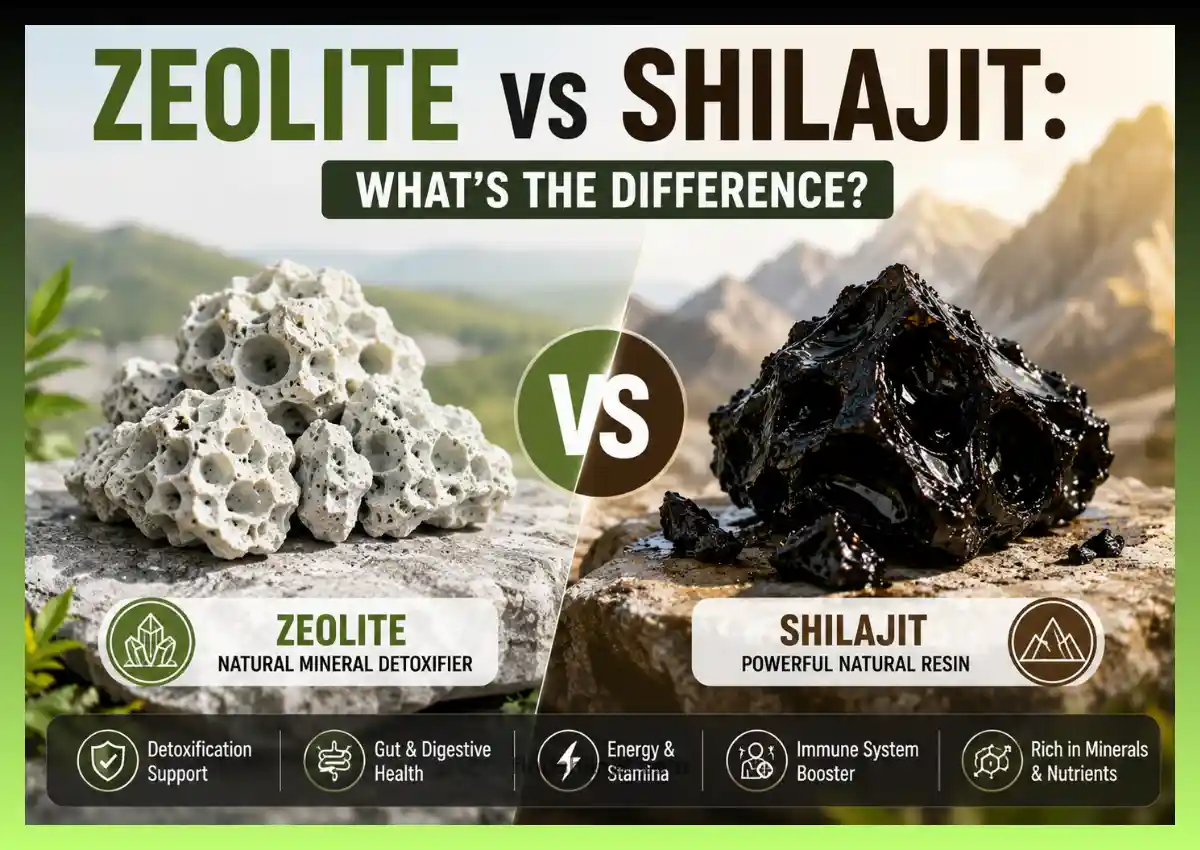
ByIf you’re comparing zeolite vs shilajit, you’re probably looking for a natural supplement that supports overall wellness. Although both are naturally occurring mineral-rich substances, they are fundamentally different in origin, composition, and intended use.
Shilajit is a mineral-rich organic substance formed from ancient mountain vegetation and is traditionally used in Ayurveda. Zeolite is a naturally occurring volcanic mineral with a unique porous structure that has applications ranging from water purification to industrial filtration. Certain forms of purified zeolite are also sold as dietary supplements, although research supporting their health benefits is still developing.
Understanding these differences can help you choose the supplement that best aligns with your health goals rather than assuming they’re interchangeable.
Zeolite vs Shilajit: Quick Comparison
| Feature | Zeolite | Shilajit |
| Natural origin | Volcanic mineral | Organic mineral resin |
| Formation | Volcanic ash and alkaline water | Ancient mountain vegetation and minerals |
| Primary compounds | Aluminosilicate minerals | Fulvic acid, humic substances, trace minerals |
| Traditional use | Industrial and environmental applications | Ayurvedic medicine |
| Supplement form | Purified zeolite powder or liquid | Purified resin, capsules or powder |
| Research focus | Detoxification and adsorption | Energy, vitality and healthy aging |
| Fulvic acid | No | Yes |
What Is Zeolite?
Zeolite is a naturally occurring mineral formed when volcanic ash reacts with alkaline groundwater over thousands of years. During this process, the mineral develops a highly organized crystal framework filled with microscopic pores.
These tiny channels give zeolite one of its most unique properties—it can trap and exchange certain positively charged ions. Scientists refer to this as ion exchange capacity, which explains why zeolite is widely used in water treatment, agriculture, environmental cleanup, and industrial filtration.
Several types of zeolite exist in nature, but clinoptilolite is the variety most commonly used in dietary supplements.
It’s important to distinguish industrial-grade zeolite from purified supplement-grade zeolite. Products intended for human consumption should undergo purification and contaminant testing because natural zeolite deposits may contain unwanted heavy metals or impurities.
What Is Shilajit?
Shilajit is a sticky, mineral-rich substance that naturally seeps from mountain rocks in regions such as the Himalayas, Altai, and Caucasus.
Unlike zeolite, shilajit does not originate from volcanic activity. It develops when ancient plants and other organic matter slowly decompose under pressure while interacting with minerals inside mountain rocks over hundreds or even thousands of years.
This natural maturation process produces a complex mixture of biologically active compounds.
Researchers commonly identify:
- Fulvic acid
- Humic substances
- Dibenzo-alpha-pyrones
- Trace minerals
- Amino acids
- Organic acids
After harvesting, raw shilajit must be purified to remove rock fragments, sand, microbial contamination, and excessive heavy metals before it is suitable as a dietary supplement.
The Biggest Difference Between Zeolite and Shilajit
Although both supplements come from nature, they work through very different mechanisms.
Zeolite is valued primarily for its physical structure. Its porous crystal framework allows it to bind certain substances through adsorption and ion exchange. This property explains why zeolite is commonly used in water filtration systems and environmental cleanup projects.
Shilajit is valued for its chemical composition. Rather than acting like a filter, it naturally contains hundreds of organic compounds and trace minerals that researchers continue to study for their biological activity.
In simple terms, zeolite functions because of its microscopic structure, while shilajit functions because of the compounds it naturally contains.
Zeolite vs Shilajit for Energy
Shilajit has traditionally been used to support energy, stamina, and physical performance.
Several clinical studies suggest purified shilajit may help support mitochondrial function, which plays an essential role in cellular energy production. Researchers believe naturally occurring compounds such as fulvic acid and dibenzo-alpha-pyrones may contribute to these effects, although more high-quality human studies are still needed.
Zeolite is not typically marketed for energy production. Instead, supplement manufacturers often promote it for detoxification or general wellness, though evidence supporting many of these claims remains limited.
If your primary goal is supporting healthy energy levels, shilajit currently has considerably more traditional use and scientific interest than zeolite.
Zeolite vs Shilajit for Detox
This is where many consumers become confused.
Zeolite supplements are frequently marketed as “detox” products because laboratory studies demonstrate their ability to bind certain substances through ion exchange.
However, laboratory behavior doesn’t automatically translate into meaningful health benefits in humans. While some early research is promising, many detox claims require larger, well-designed clinical trials before firm conclusions can be made.
Shilajit is generally not promoted as a detoxifying agent. Instead, research has focused on its antioxidant properties, mineral content, and potential role in supporting normal cellular function.
Rather than asking which supplement is better for detox, it’s more accurate to evaluate each based on the evidence available for its intended purpose.
Can You Take Zeolite and Shilajit Together?
Yes, some people choose to take both zeolite and shilajit because they serve different purposes. Shilajit is primarily used to support energy production, healthy aging, and mineral replenishment, while zeolite supplements are commonly marketed for their ability to bind certain substances in the digestive tract.
However, there is currently limited clinical research evaluating the combined use of zeolite and shilajit in humans. That means there isn’t enough evidence to say whether taking them together provides additional health benefits compared to using either supplement alone.
One practical consideration is timing. Because zeolite has adsorption properties, some healthcare professionals recommend taking it separately from medications and other supplements. Although research specifically involving shilajit is limited, separating the two by 2 to 3 hours may help reduce the possibility of zeolite binding to minerals or other compounds before they can be absorbed.
If your primary goal is improving energy, stamina, and overall vitality, shilajit may be the more appropriate choice. If you’re specifically interested in purified clinoptilolite for its adsorption properties, zeolite may better match that purpose.
Before combining multiple supplements, especially if you have a medical condition, take prescription medications, or are pregnant or breastfeeding, consult a qualified healthcare professional.
Safety Considerations
Neither zeolite nor shilajit should be purchased solely based on price.
Because both originate from natural geological environments, contamination is an important quality concern.
A reputable manufacturer should provide independent laboratory testing for:
- Heavy metals
- Microbial contamination
- Product identity
- Purity
- Batch-specific quality control
This is especially important because natural mineral products can vary significantly depending on where they were collected.
Consumers should also avoid products making unrealistic claims such as curing diseases or eliminating all toxins from the body. Such claims are not supported by current scientific evidence.
How to Choose a High-Quality Zeolite or Shilajit Supplement
The quality of a supplement matters just as much as the ingredient itself. Both zeolite and shilajit are naturally sourced, meaning their purity depends on where they were collected, how they were processed, and whether they were independently tested.
When Buying Shilajit
Choose a product that:
- Uses purified rather than raw shilajit.
- Provides a recent Certificate of Analysis (COA).
- Has independent third-party testing.
- Screens for heavy metals and microbial contamination.
- Clearly states the geographical source.
- Lists the form of shilajit, such as resin, capsules, or powder.
Avoid products that promise instant cures or claim unrealistically high fulvic acid percentages without laboratory evidence.
When Buying Zeolite
Look for supplements that:
- Use purified clinoptilolite zeolite.
- Undergo independent heavy metal testing.
- Provide batch-specific quality reports.
- Are manufactured in facilities that follow Good Manufacturing Practices (GMP).
- Clearly disclose ingredients and serving size.
Be cautious of products claiming to remove every toxin from the body or guarantee complete detoxification. Current scientific evidence does not support such broad claims.
Quick Quality Checklist
Before purchasing either supplement, make sure the brand offers:
- Independent third-party laboratory testing.
- Batch-specific Certificate of Analysis (COA).
- Heavy metal screening.
- Microbial safety testing.
- Transparent ingredient sourcing.
- Clear manufacturing information.
- Evidence-based claims instead of exaggerated marketing.
Choosing a well-tested product from a transparent manufacturer is one of the most effective ways to ensure you’re getting a supplement that meets quality and safety standards.
How to Choose Between Zeolite and Shilajit
The better option depends on why you’re considering supplementation.
Shilajit may be more appropriate for individuals interested in traditional Ayurvedic wellness and a supplement with naturally occurring fulvic acid, humic substances, and trace minerals.
Zeolite may appeal to individuals specifically interested in purified clinoptilolite supplements, although it’s important to recognize that many marketed detox claims require additional clinical evidence.
Regardless of which supplement you choose, prioritize products that provide transparent sourcing, independent third-party testing, and recent Certificates of Analysis.
Frequently Asked Questions
Is zeolite the same as shilajit?
No. Zeolite is a volcanic aluminosilicate mineral, while shilajit is an organic mineral-rich substance formed from decomposed mountain vegetation.
Which contains fulvic acid?
Authentic shilajit naturally contains fulvic acid. Zeolite does not.
Which is better for energy?
Current research and traditional use support shilajit more strongly for energy and vitality than zeolite.
Can zeolite replace shilajit?
No. Their composition, biological properties, and intended uses are entirely different.
Is laboratory testing important for both?
Yes. Both supplements should be independently tested for heavy metals, microbial contamination, and purity before being sold for human consumption.
Final Verdict
Although zeolite and shilajit are both natural mineral-derived products, they are designed for different purposes.
Zeolite is a volcanic mineral recognized for its porous crystal structure and adsorption properties. Shilajit is a complex organic substance naturally rich in fulvic acid, humic substances, and trace minerals that has been used in traditional Ayurvedic medicine for centuries.
If your goal is supporting energy, vitality, and traditional wellness, shilajit has stronger historical use and a broader body of scientific research. If you’re considering zeolite, choose a purified product from a manufacturer that provides independent laboratory testing and avoid relying on unsupported detox claims.
Ultimately, the best supplement is one that matches your health goals and is backed by transparent quality testing rather than marketing promises.
Also Read:
Ginseng vs Shilajit: Which Adaptogen Is Better?
Almonds vs Shilajit: Which Is Better?
Alpha Shilajit Nabhi Oil Benefits in Hindi
References
- NIH Office of Dietary Supplements
- U.S. Food & Drug Administration – Dietary Supplements
- PubMed
- National Center for Biotechnology Information (NCBI)
- United States Pharmacopeia (USP)
- AOAC INTERNATIONAL
- International Zeolite Association (IZA)
- PubChem
Disclaimer
This article is for informational purposes only. Please consult a licensed healthcare provider before starting any new supplement, especially if you are pregnant, breastfeeding, or on medication.

Reviewed by: Dr. Natha Thomas, PhD (USA)
Nutrition and supplement research professional interested in nutritional science, dietary supplements, nutrient bioavailability, scientific literature, and how research findings are communicated to consumers.
View full profile →Medical review date: July 25, 2026