 By
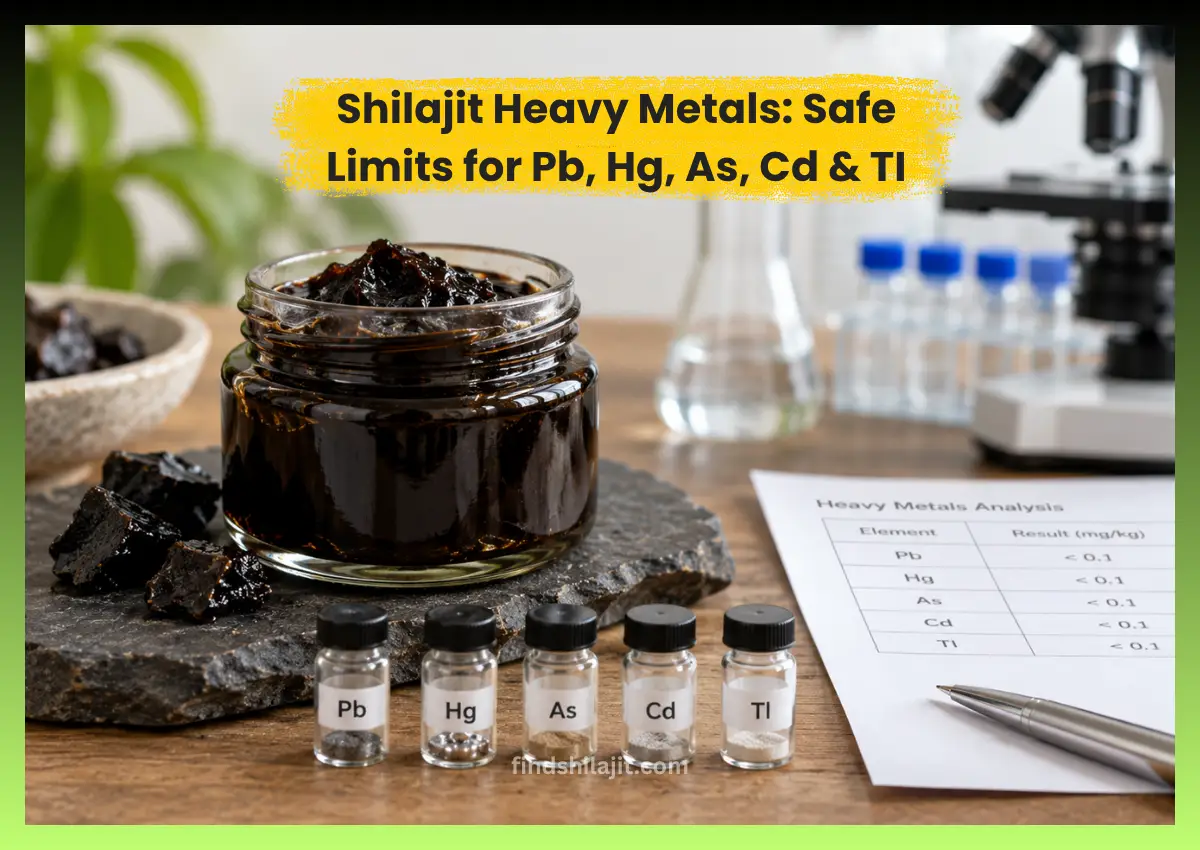
ByShilajit comes from rock in high-altitude regions like the Himalayas. That rock sits in soil that naturally holds lead, mercury, arsenic, cadmium and, as more recent testing has shown, thallium too. So the question isn’t whether shilajit can contain trace heavy metals. It’s how much, and whether that amount is safe for a normal daily serving.
This guide walks through the actual US testing limits, a metal most COAs don’t even check for, what a Certificate of Analysis (COA) should show, and how to read the numbers instead of trusting a marketing claim.
One thing up front: there is no single “safe ppm” that applies to every shilajit product. Limits depend on whether you’re testing the raw resin or the finished capsule, how many grams you take per day, and which standard a lab is testing against.
The Metals Labs Should Check
Most reputable shilajit COAs test for four elements. A fifth is showing up in newer research and is worth asking about directly, since it’s rarely on a standard panel.
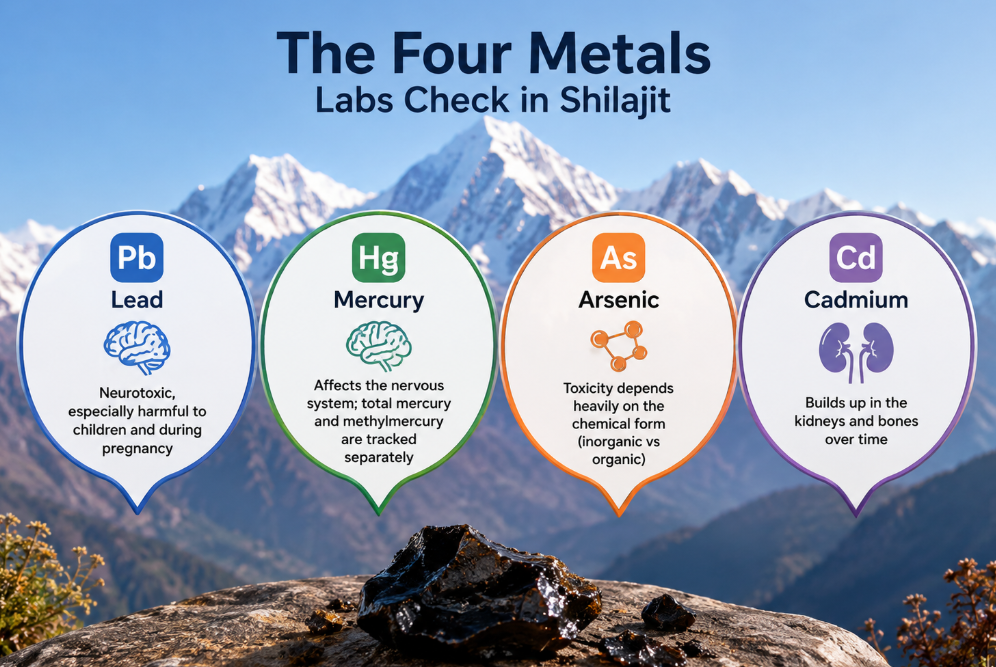
- Lead (Pb): neurotoxic, especially harmful to children and during pregnancy
- Mercury (Hg): affects the nervous system; total mercury and methylmercury are tracked separately
- Arsenic (As): toxicity depends heavily on the chemical form (inorganic vs organic)
- Cadmium (Cd): builds up in the kidneys and bones over time
- Thallium (Tl): a toxic trace element not covered by most standard “big four” panels — see below
The Overlooked Fifth Metal: Thallium
Most shilajit safety guides — and most COAs — stop at lead, mercury, arsenic, and cadmium. A 2025 peer-reviewed study in BMC Chemistry measured thallium specifically in both crude shilajit and commercial shilajit supplements, and found something worth knowing before you assume a “big four” pass means the product is clean [7].
What the study found:
- Thallium was detected in crude shilajit samples up to 0.226 µg per gram, with levels varying significantly by geographic origin — an Indian sample tested lowest, at 0.007 µg/g.
- In the six commercial supplements tested, thallium reached up to 0.5 µg per gram, and in three of the six, thallium was higher in the finished supplement than in any of the crude shilajit samples tested. That’s not what you’d expect if processing only removed contaminants — it’s a reminder that manufacturing steps can introduce trace elements too, not just remove them.
- The highest single tablet measured contained 0.095 µg of thallium; at two tablets a day, that works out to roughly 0.19 µg/day from that product.
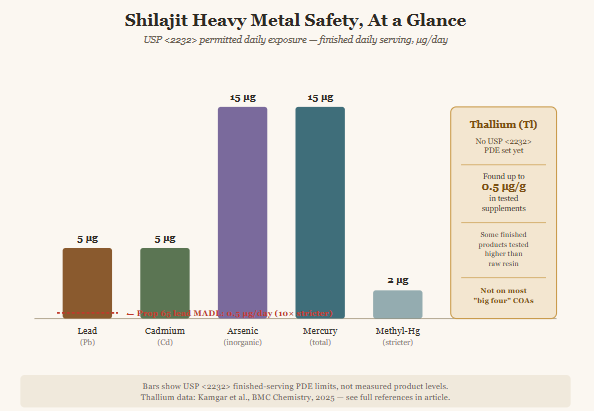
There isn’t yet a USP <2232> PDE specifically established for thallium in dietary supplements the way there is for lead, cadmium, arsenic, and mercury, so there’s no official daily limit to compare that number against. That’s exactly why it’s worth asking about directly — a brand can pass every standard heavy-metal panel and never have tested for thallium at all. If a COA doesn’t list it, ask whether the lab’s method (ICP-MS panels typically can include it) was scoped to test for it.
US Safe Limits for Shilajit Heavy Metals
The main US reference point is USP General Chapter <2232>, Elemental Contaminants in Dietary Supplements. It sets a Permitted Daily Exposure (PDE) for a finished supplement’s full daily serving, and a separate, stricter limit for testing a raw ingredient before it’s diluted into a formula.
Finished product limit (whole daily serving, µg/day):
| Metal | Symbol | USP <2232> PDE |
| Lead | Pb | 5 mcg/day |
| Cadmium | Cd | 5 mcg/day |
| Arsenic (inorganic) | As | 15 mcg/day |
| Mercury (total) | Hg | 15 mcg/day |
| Methylmercury | CH3Hg | 2 mcg/day |
Raw ingredient limit (µg/g, assumes up to 10g of that ingredient per day):
| Metal | Symbol | USP <2232> component limit |
| Lead | Pb | 0.5 µg/g |
| Cadmium | Cd | 0.5 µg/g |
| Arsenic (inorganic) | As | 1.5 µg/g |
| Mercury (total) | Hg | 1.5 µg/g |
| Methylmercury | CH3Hg | 0.2 µg/g |
(Figures above reflect USP <2232> as currently published on USP-NF; USP periodically revises elemental-impurity chapters, so it’s worth checking uspnf.com for the current effective version if you’re citing this for compliance purposes rather than general reading.)
These aren’t legal requirements the way FDA drug rules are. Dietary supplements in the US fall under DSHEA, and USP <2232> is a voluntary quality standard that reputable manufacturers choose to test against. A brand can technically sell a product that never touched this chapter.
There’s also a second, much stricter number that shows up on shilajit labels sold in the US: California’s Proposition 65 Maximum Allowable Dose Level (MADL) for lead, set at 0.5 mcg per day. That’s 10 times lower than the USP finished-product limit. It’s why you’ll sometimes see a Prop 65 warning on a shilajit bottle that still passes USP testing. The MADL isn’t a toxicity threshold. OEHHA set it at 1,000 times below the lowest dose shown to cause reproductive harm in studies, so crossing it doesn’t mean the product is dangerous. It means California requires a warning label.
What ppm Actually Means
1 ppm equals 1 milligram of a substance per kilogram of product, or roughly 1 drop in a large bathtub of water. Lab results are usually reported in ppm or ppb (1,000 ppb = 1 ppm), sometimes as µg/g (which is the same as ppm).
If a COA lists 0.4 ppm lead, that means 0.4 mg of lead per kilogram of shilajit. To know if that’s a problem, multiply it by your actual daily serving size, not the whole jar.
Example: a 500 mg daily serving of shilajit testing at 0.4 ppm lead works out to 0.2 mcg of lead in that day’s dose. That’s well under both the USP 5 mcg/day limit and the Prop 65 MADL of 0.5 mcg/day.
Why Shilajit Contains Heavy Metals in the First Place
Shilajit forms over centuries from decomposed plant matter compressed under rock layers. It picks up whatever minerals sit in that geology, which naturally includes trace lead, arsenic, mercury, cadmium — and thallium — alongside beneficial minerals like fulvic acid, iron and magnesium.
Contamination can also come from:
- Industrial pollution or mining runoff near the collection site
- Contaminated water used during processing
- Poor storage or transport, especially in unlined metal containers
- Adulteration, where cheaper fillers are added and bring their own contaminants
Purification (heating, filtering, or the traditional Ayurvedic shodhana process) reduces some contaminants but doesn’t guarantee low heavy metal content on its own — and, as the thallium data above shows, processing steps can sometimes add trace elements rather than only removing them. Testing the finished batch is the only way to know.
Lead in Shilajit
Lead is the metal most consumer advocacy groups focus on because it’s neurotoxic at low doses and accumulates in bone over years. A COA should report a specific lead value, not just “pass” or “below limit.” If a lab reports “below detection limit” (BDL), check what that detection limit actually is. A lab with a 1 ppm detection limit calling something BDL tells you far less than one with a 0.01 ppm limit.
Mercury in Shilajit
Labs usually test for total mercury first. If total mercury comes in under the methylmercury limit (2 mcg/day per USP <2232>), a separate methylmercury test usually isn’t required, since methylmercury is the more toxic and more bioavailable form. If total mercury is elevated, ask whether the brand ran a methylmercury speciation test.
Arsenic in Shilajit
Total arsenic and inorganic arsenic are not the same thing. Inorganic arsenic is the toxic form regulators care about; organic arsenic compounds (common in some foods) are far less concerning. Some labs report total arsenic and assume it’s all inorganic unless it exceeds the limit, in which case they run a speciation test to confirm. A COA that only says “arsenic: pass” without specifying total vs inorganic is giving you less information than it should.
Cadmium in Shilajit
Cadmium exposure builds up over decades and mainly affects the kidneys. It typically enters shilajit through soil and groundwater rather than processing. Because cadmium accumulates, consistent daily use of a borderline product matters more than a single high reading would for a metal that clears the body faster.
How Labs Test for Heavy Metals in Shilajit
Reputable labs use ICP-MS (inductively coupled plasma mass spectrometry) or ICP-OES (optical emission spectrometry). USP names both among its accepted procedures for elemental impurities, and both can detect metals down to parts-per-billion levels — ICP-MS can also be scoped to include thallium, which isn’t always part of a default “big four” panel. Cheaper qualitative test strips exist but don’t give the precision needed to compare against a µg/day limit. If a brand’s COA doesn’t name the testing method, that’s worth asking about directly.
How to Read a Shilajit COA
Before trusting a product, check the COA for:
- Test date within the last 12 to 18 months
- A batch or lot number that matches the jar you’re holding
- The name of the testing lab (search for it independently)
- The testing method (ICP-MS or ICP-OES)
- A specific lead value in mcg or ppm, not just “pass”
- A specific mercury value, noting total vs methylmercury
- A specific arsenic value, noting total vs inorganic
- A specific cadmium value
- Whether thallium was included in the panel at all
- A comparison to a named standard (USP <2232>, not just “safe”)
- Lab accreditation (ISO 17025 is a good sign)
Does Detecting Heavy Metals Mean Shilajit Is Unsafe?
No. Trace detection is normal and expected for a mineral-based product. Toxicity depends on the amount, the chemical form, and how often you take it, not on whether a sensitive instrument can find a trace at all. A lab using ICP-MS can detect metals in the parts-per-billion range, so “zero heavy metals” on a label usually means the test wasn’t sensitive enough to find anything, not that nothing is there.
What matters is whether your actual daily dose, at your actual serving size, stays under the PDE limits above.
What to Look For Before Buying
Don’t judge a shilajit product by color, texture, or where it claims to be sourced. Himalayan origin doesn’t guarantee low contamination, and darker resin isn’t automatically purer.
Instead:
- Ask for the current batch’s COA, not a generic one from the brand’s website
- Compare the individual Pb, Hg, As and Cd values against USP <2232>
- Ask specifically whether thallium was tested, since it’s often left off by default
- Check your actual daily serving size against the numbers on the COA
- Confirm the testing method and lab
Red Flags
- No COA available on request
- COA has no batch number, so you can’t confirm it matches your product
- No named laboratory
- Only a blanket “heavy metals: pass,” with no individual values
- No testing method listed
- A COA more than 2 years old
- Results with no units (a number alone means nothing)
- Marketing claims of “100% heavy metal free,” which no ICP-MS test can actually confirm
FAQ
Is shilajit naturally high in heavy metals?
It naturally contains trace amounts because of its geological origin, but “high” depends on the specific deposit and how it was processed. Good sourcing and purification keep levels low.
What is a safe lead level in shilajit?
Under USP <2232>, a finished daily serving should stay under 5 mcg of lead. California’s Prop 65 warning threshold is stricter, at 0.5 mcg/day.
What is the acceptable mercury level in shilajit?
15 mcg/day total mercury, or 2 mcg/day if it’s methylmercury, per USP <2232>.
How much arsenic is safe in shilajit?
15 mcg/day of inorganic arsenic per USP <2232>. Total arsenic figures should specify whether they’re inorganic or include less toxic organic forms.
What is the cadmium limit for shilajit?
5 mcg/day for a finished daily serving, per USP <2232>.
Does shilajit contain thallium?
It can. A 2025 study found measurable thallium in both crude shilajit and finished supplements, with some supplements testing higher than the raw material [7]. There’s no official USP daily limit for thallium yet, and most standard panels don’t test for it, so it’s worth asking a brand directly.
Does purified shilajit contain heavy metals?
It can. Purification reduces some contaminants but doesn’t remove all trace minerals, since heavy metals can be chemically bound into the resin itself.
Can a COA prove shilajit is safe?
It shows what was in that specific batch on that specific test date. It’s the best evidence available, but it doesn’t cover every batch a brand has ever sold.
How are heavy metals tested in shilajit?
Mainly ICP-MS and ICP-OES, both able to detect metals at parts-per-billion levels.
Final Takeaway
Skip the color and origin claims and go straight to the COA. Check lead, mercury, arsenic and cadmium individually, ask whether thallium was tested, confirm the testing method, and do the math on your actual daily serving against the USP <2232> limits above. A product that’s transparent about all of that is a better sign than any packaging claim.
Also Read:
Scientific References
- United States Pharmacopeia, General Chapter <2232> Elemental Contaminants in Dietary Supplements. USP-NF. uspnf.com/notices/general-chapter-elemental-contaminants-dietary-supplements
- USP General Chapter <233> Elemental Impurities – Procedures. usp.org — 233_ElementalImpuritiesProcedures.pdf
- California Office of Environmental Health Hazard Assessment (OEHHA), Proposition 65 No Significant Risk Levels and Maximum Allowable Dose Levels. oehha.ca.gov
- U.S. FDA, Dietary Supplement Health and Education Act (DSHEA) overview of supplement regulation. fda.gov/food/dietary-supplements
- USP General Chapter <232> Elemental Impurities — Limits (drug products reference table, for context on how PDEs are derived). usp.org — 232_ElementalImpuritiesLimits.pdf
- USP <2232> Elemental Contaminants in Dietary Supplements — PDE reference table (PQRI). pqri.org — 12-USP-2232-Elemental-Contaminants-In-Dietary-Supplements-KG.pdf
- Kamgar E, Zembrzuska J, Zembrzuski W, Kaykhaii M. Quantifying of thallium in Shilajit and its supplements to unveil the potential risk of consumption of this popular traditional medicine. BMC Chemistry, 2025;19(1):20. pmc.ncbi.nlm.nih.gov/articles/PMC11743217
Disclaimer
This article is for informational purposes only and isn’t medical advice. These statements haven’t been evaluated by the FDA. Dietary supplements aren’t intended to diagnose, treat, cure, or prevent any disease. Talk to a licensed healthcare provider before starting any new supplement, especially if you’re pregnant, breastfeeding, taking medication, or managing a health condition. If you experience an adverse reaction, stop use and contact your doctor, or report it to the FDA through MedWatch.

Hi, I’m Emily Thomson, a wellness researcher and the voice behind Find Shilajit. I have explored and tested over 30 types of Shilajit from brands around the world, so you don’t have to. After experiencing its potential benefits firsthand, I became interested in learning more about Shilajit and began researching products, analyzing reviews across major e-commerce platforms, and creating clear, helpful content.
Many of the articles I publish are medically reviewed by a licensed practitioner to help ensure the information is accurate, safe, and genuinely useful, not just good-sounding.
Here, you’ll find research-based insights, honest reviews, and straightforward product comparisons. Based in Denver, USA, my mission is simple: to share authentic and trustworthy Shilajit knowledge with readers worldwide.