
 By
ByYes, Shilajit and Magnesium can be taken together, and it’s actually one of the more natural pairings you can build a supplement routine around. Shilajit already contains trace amounts of magnesium as one of its 80+ minerals, so adding a dedicated magnesium supplement doesn’t create any conflict — it simply builds on what’s already there.
These two work in different ways, though, so it helps to understand what each one is actually doing before you decide on dosage or timing.
What Is Shilajit?
Shilajit is a mineral-rich resin that forms over centuries in high-altitude mountain rock, most commonly sourced from the Himalayas and Altai ranges. It contains fulvic acid along with dozens of trace minerals, and it’s traditionally used to support:
- Daily energy and stamina
- Exercise recovery
- Healthy testosterone levels in men
- Nutrient absorption
- Cognitive function
What Is Magnesium?
Magnesium is an essential mineral involved in over 300 enzymatic reactions in the body. Unlike shilajit, it isn’t a plant or mineral extract with dozens of compounds — it’s a single, well-studied nutrient, and a large percentage of adults don’t get enough of it from diet alone.
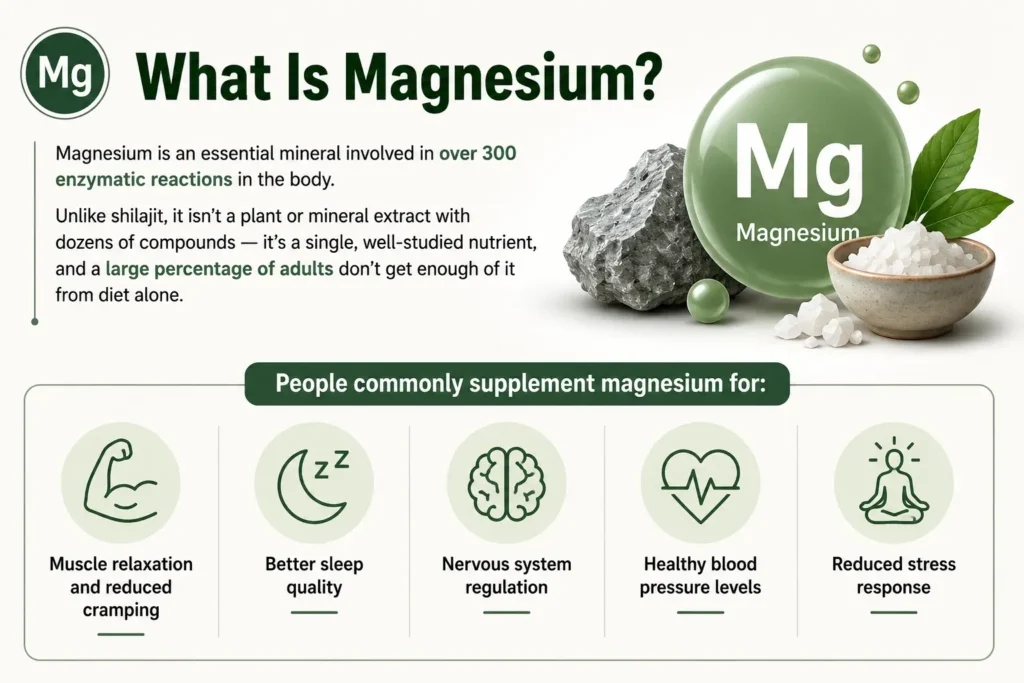
People commonly supplement magnesium for:
- Muscle relaxation and reduced cramping
- Better sleep quality
- Nervous system regulation
- Healthy blood pressure levels
- Reduced stress response
Best Type of Magnesium to Take with Shilajit
Not all magnesium supplements work the same way. Choosing the right form depends on your health goals, whether that’s better sleep, muscle recovery, or brain support. Pairing Shilajit with a well-absorbed form of magnesium can help you get the most from both supplements.
| Magnesium Type | Best For | Pairs Well with Shilajit? |
| Magnesium Glycinate | Better sleep, stress relief, muscle relaxation | ⭐ Recommended for most people |
| Magnesium Citrate | Constipation and general magnesium support | ✔ Good option |
| Magnesium Malate | Daytime energy and muscle soreness | ✔ Good for active individuals |
| Magnesium L-Threonate | Brain health, memory, and focus | ✔ Good if cognitive support is your goal |
| Magnesium Oxide | Occasional constipation | ⚠ Less ideal because it is absorbed poorly and may cause digestive upset |
If you’re unsure which one to choose, magnesium glycinate is often the best starting point because it is gentle on the stomach and commonly used to support relaxation and sleep.
Why People Combine Shilajit and Magnesium
Shilajit is often taken for energy and performance, while magnesium is taken for relaxation, sleep, and muscle recovery. On paper these sound like they’d cancel each other out, but in practice they tend to support two different parts of the same daily cycle:
- Shilajit supports the energy you use during the day
- Magnesium supports the recovery and relaxation your body needs afterward
Because shilajit already contains some magnesium naturally, this combination is less about “stacking two separate ingredients” and more about topping up a mineral your body may already be running low on.
Benefits of Taking Shilajit and Magnesium Together
1. Better Muscle Recovery
Magnesium plays a direct role in muscle relaxation and reducing cramping, while shilajit supports the cellular energy production needed for tissue repair. Together, they’re a common pairing for people who train regularly.
2. Improved Sleep Quality
Magnesium is one of the more well-supported natural options for sleep support, particularly for people who have trouble staying asleep. Taking shilajit earlier in the day and magnesium in the evening can support both energy and rest without the two competing.
3. Reduced Stress Response
Magnesium plays a role in regulating the nervous system, and low magnesium levels have been associated with increased stress sensitivity. Pairing it with shilajit’s mineral profile may offer broader support than either one alone.
4. Support for Healthy Blood Pressure
Magnesium is one of the more researched minerals for supporting already-healthy blood pressure levels. This is also one of the areas where you’ll want to be more careful — see the caution section below if you’re on blood pressure medication.
5. Better Nutrient Absorption
Shilajit’s fulvic acid is known for its role as a nutrient transporter, which may support how efficiently minerals like magnesium are absorbed and used by the body.
What Does Research Say About Taking Shilajit and Magnesium Together?
There are currently no clinical studies that specifically examine taking Shilajit and magnesium together. However, research on each supplement individually suggests they may complement one another.
Studies have found that magnesium plays an essential role in muscle function, nerve signaling, energy production, and sleep quality. People with low magnesium levels may experience fatigue, muscle cramps, or difficulty sleeping, and correcting a deficiency can improve these symptoms.
Research on purified Shilajit suggests it may help support mitochondrial function—the process your cells use to produce energy. Its naturally occurring fulvic acid may also assist with transporting minerals and other nutrients within the body.
While more research is needed on this specific combination, their different roles in the body suggest they can be used together as part of a balanced wellness routine when taken in appropriate doses. Neither supplement should be viewed as a substitute for a healthy diet, regular exercise, or medical treatment.
Who May Benefit Most
This combination may be useful for adults who:
- Train regularly and deal with muscle cramping or soreness
- Have trouble winding down at night
- Feel tired during the day but wired at night
- Have a diet lower in magnesium-rich foods (leafy greens, nuts, seeds)
- Are already taking shilajit and want to round out their mineral intake
Recommended Dosage
| Supplement | Typical Daily Amount |
| Shilajit Resin | 250–500 mg |
| Purified Shilajit Capsules | 250–500 mg |
| Magnesium Glycinate or Citrate | 200–400 mg elemental magnesium |
Magnesium comes in several forms, and they’re not interchangeable. Magnesium glycinate and magnesium citrate are generally better tolerated for daily use than magnesium oxide, which is more commonly associated with digestive upset.
If you’re new to either supplement, start at the lower end of both ranges.
How to Stack Shilajit and Magnesium
Morning
- Shilajit (250–500 mg)
- With breakfast or warm water
Evening
- Magnesium (200–400 mg elemental)
- After dinner or 30-60 minutes before bed
| Goal | Suggested Timing |
| More daytime energy | Shilajit in the morning |
| Better sleep | Magnesium in the evening |
| Muscle recovery after training | Magnesium post-workout or before bed |
| Convenience | Both with breakfast (less ideal for sleep support) |
Can You Take Shilajit and Magnesium at the Same Time?
Yes, you can take Shilajit and magnesium together. There are no known interactions that require healthy adults to separate them. However, taking them at different times of the day may help you get the most benefit from each supplement.
For example, many people take Shilajit in the morning because it supports daytime energy and stamina. Magnesium is often taken after dinner or before bed, especially magnesium glycinate, since it may help the body relax and support restful sleep.
If convenience is more important than timing, taking both with a meal is generally fine. The most important factor is taking them consistently rather than worrying about the exact hour.
How Long Does It Take to Notice Benefits?
- Muscle relaxation and cramping relief from magnesium: often within the first week
- Sleep quality improvements: typically 1-2 weeks of consistent use
- Shilajit’s energy and stamina effects: 2-4 weeks
- Combined recovery and stress benefits: usually most noticeable by week 4-6
Are There Any Side Effects?
Most healthy adults tolerate both supplements well when taken as directed.
Shilajit
- Mild stomach discomfort
- Digestive upset if taken on an empty stomach
- Rare allergic reactions
Magnesium
- Loose stools or diarrhea, especially at higher doses or with magnesium oxide
- Mild stomach cramping
- Drowsiness (more common with magnesium glycinate)
If you experience diarrhea, it usually means the dose is too high for your system — cutting back is often enough to resolve it.
Who Should Avoid This Combination
Speak with a healthcare professional before combining shilajit and magnesium if you:
- Are pregnant or breastfeeding
- Have chronic kidney disease (the kidneys regulate magnesium, and impaired function increases the risk of magnesium buildup)
- Take blood pressure medication
- Take diabetes medication
- Have a heart condition or take heart medication
- Take antibiotics (magnesium can interfere with absorption of certain antibiotics — space doses by at least 2 hours)
- Have iron overload disorders
Kidney health is the one that deserves extra attention here specifically because it applies to magnesium in a way it doesn’t apply to most other supplement pairings — healthy kidneys clear excess magnesium efficiently, but impaired kidney function changes that equation.
Tips for Best Results
- Choose purified, lab-tested shilajit
- Use magnesium glycinate or citrate over magnesium oxide for better tolerance
- Take magnesium in the evening if sleep is a priority
- Stay consistent — mineral-based supplements tend to work cumulatively, not instantly
- Don’t increase either dose faster than every 1-2 weeks
Common Mistakes to Avoid
- Choosing magnesium oxide for convenience and ending up with digestive issues
- Taking both supplements at the same time when the goal is better sleep (shilajit’s energizing effect can work against that)
- Expecting overnight results
- Skipping the kidney-function check if you have any history of kidney issues
- Buying unpurified shilajit, which carries a higher contamination risk
My Experience
I switched to magnesium after months of shilajit alone left me energized all day but wired at 11pm, staring at the ceiling. First tried magnesium oxide because it was cheap at my local pharmacy, and it just gave me loose stools within days. Switched to glycinate, took it after dinner instead of with breakfast, and within about 10 days I was actually falling asleep without scrolling my phone for an hour first.
Frequently Asked Questions
Can I take Shilajit and Magnesium every day?
Yes, most healthy adults can take them daily at the doses listed above, provided a healthcare provider hasn’t advised otherwise.
Should I take magnesium on an empty stomach?
Most people tolerate magnesium better with food, which also reduces the chance of stomach upset.
Can women take Shilajit and Magnesium together?
Yes. Many women use this combination, particularly for sleep and muscle recovery. Pregnant or breastfeeding women should avoid both unless advised by a healthcare professional.
Can I take magnesium instead of shilajit for energy?
No — they serve different purposes. Magnesium supports relaxation and recovery, while shilajit is more associated with daytime energy and stamina. They complement rather than replace each other.
Is this combination safe for long-term use?
Generally yes for healthy adults, though anyone with kidney concerns should have this specific combination reviewed by a doctor before long-term use, given magnesium’s kidney-dependent clearance.
Final Thoughts
Shilajit and magnesium are a natural pairing — shilajit already contains trace magnesium, and adding a dedicated magnesium supplement rounds out the mineral support rather than layering on something unrelated. Shilajit tends to support daytime energy and performance, while magnesium supports evening relaxation, sleep, and muscle recovery. Taken at the right times and at reasonable doses, most healthy adults tolerate this combination well — just pay closer attention if you have any history of kidney issues, since magnesium clearance depends directly on kidney function.
References:
Magnesium — Fact Sheet for Health Professionals
Magnesium — Consumer Fact Sheet
Shilajit: A Natural Phytocomplex with Potential Procognitive Activity
Also Read:
Ozokerite vs Shilajit: What’s the Difference?
Shilajit vs Alcohol: What Actually Happens Inside Your Body?
Can You Take Shilajit and Ashwagandha Together?
Disclaimer
This article is for informational purposes only. Please consult a licensed healthcare provider before starting any new supplement, especially if you are pregnant, breastfeeding, or on medication.

Reviewed by: Dr. Natha Thomas, PhD (USA)
Nutrition and supplement research professional interested in nutritional science, dietary supplements, nutrient bioavailability, scientific literature, and how research findings are communicated to consumers.
View full profile →Medical review date: August 7, 2026