 By
ByIf you take levothyroxine or another thyroid medication, talk to your doctor before adding shilajit. The concern isn’t that shilajit is dangerous on its own. It’s that shilajit contains trace iodine and minerals that can interact with how your thyroid medication is absorbed or how your thyroid responds to iodine, especially if you have Hashimoto’s or Graves’ disease.
What’s in shilajit that matters here
Shilajit is a resin that forms in mountain rock, mainly in the Himalayas and Altai ranges. It contains fulvic acid, humic acid, and trace amounts of iodine, selenium, iron, and calcium.
None of these are present in the same concentrations you’d get from a dedicated iodine or selenium supplement. But trace amounts still count when you’re managing a condition where hormone dosing is precise.
The absorption problem: calcium and iron
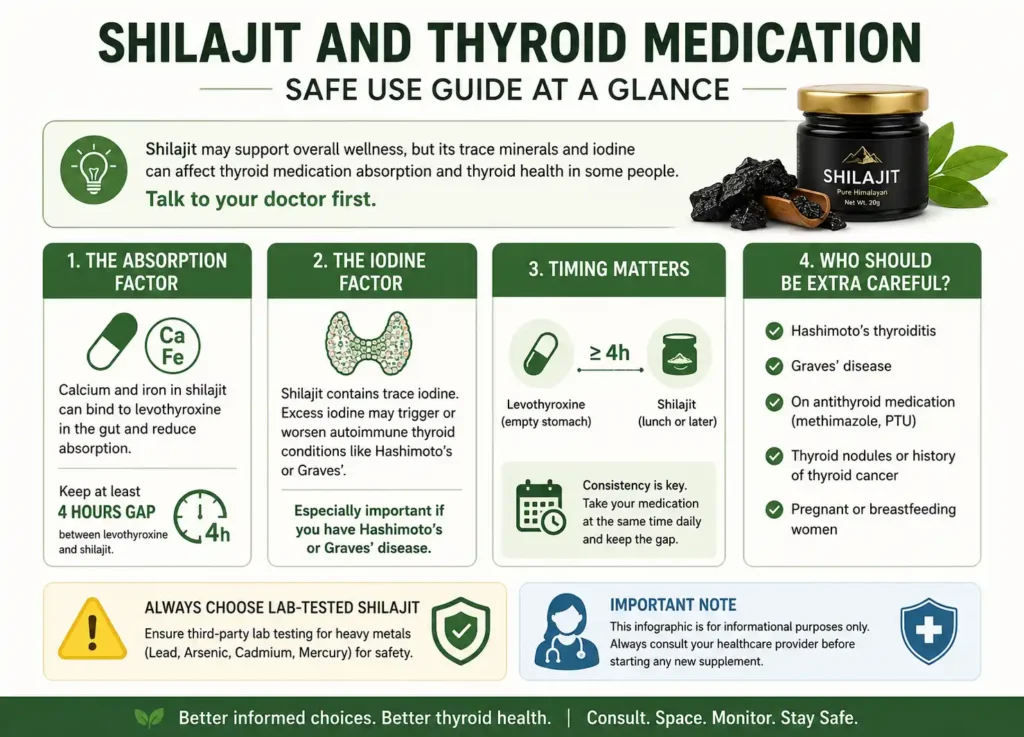
Calcium and iron bind to levothyroxine in the gut and form compounds your body can’t absorb. The FDA’s own labeling for levothyroxine lists calcium supplements, iron supplements, and phosphate binders as requiring a 4-hour separation from your dose. Research on calcium formulations found each one cuts levothyroxine absorption by roughly 15 to 25% when taken together. Iron works the same way. There are documented cases of patients becoming hypothyroid after starting an iron supplement, then swinging hyperthyroid when they stopped the iron without adjusting their levothyroxine dose back down.
Shilajit’s calcium and iron content is small compared to a multivitamin or a dedicated iron tablet. But the mechanism is identical, so the same spacing rule applies.
The iodine problem: more relevant if you have Hashimoto’s or Graves’
Iodine is essential for making thyroid hormone. But excess iodine intake is also a documented driver of autoimmune thyroid disease. Studies on thyroid follicular cells show that high iodine levels trigger oxidative stress and cell death pathways involved in Hashimoto’s thyroiditis. A widely cited study followed people with borderline-elevated thyroid antibodies and found that the group with the highest iodine exposure (urinary iodine around 634 to 651 mcg/L) had the highest rate of progression to autoimmune thyroiditis, compared to groups with sufficient iodine levels (214 to 243 mcg/L).
The generally accepted safe range for urinary iodine is 100 to 300 mcg/L. Most people don’t know their own number without testing.
If you have Hashimoto’s, Graves’ disease, or any autoimmune thyroid condition, adding an iodine-containing supplement on top of your baseline diet is not something to decide on your own. If you have a straightforward case of hypothyroidism from a non-autoimmune cause, the iodine risk is lower, but it’s still worth a conversation with your doctor since shilajit isn’t dosed or labeled the way a supplement built for thyroid support would be.
Selenium: shilajit isn’t a real source of it
You’ll see shilajit marketed as supporting thyroid health because of its selenium content. Be skeptical of that claim.
Selenium research for Hashimoto’s uses doses of 50 to 100 mcg per day, usually as selenomethionine, with serum selenium levels above 80 mcg/L associated with better outcomes. Shilajit’s selenium content is a trace amount, not a standardized therapeutic dose. If your doctor thinks selenium supplementation would help you, that’s a decision for a dedicated selenium supplement with a known dose, not shilajit.
If you’re on antithyroid medication for hyperthyroidism
Most of what’s written about shilajit and thyroid medication focuses on levothyroxine and hypothyroidism. If you’re on methimazole or another antithyroid drug for hyperthyroidism or Graves’ disease, the iodine concern runs the other way: extra iodine can counteract what your medication is trying to do. This is a specific reason to check with your endocrinologist before adding shilajit, not a general precaution.
Heavy metal contamination adds a separate risk
This isn’t a thyroid-specific issue, but it matters more when you’re already managing a chronic condition with regular bloodwork.
Shilajit forms in rock over centuries and can pick up lead, arsenic, cadmium, and mercury from its surroundings. The FDA’s adult exposure limits are 130 mcg/day for arsenic, 20 mcg/day for mercury, 75 mcg/day for lead, and 55 mcg/day for cadmium. Peer-reviewed testing has found some commercial shilajit products exceeding safe thresholds, particularly unpurified or poorly sourced ones. Cadmium in particular is linked to kidney damage, which matters if you’re also taking medication that your kidneys need to process consistently.
Buy only shilajit with third-party lab testing (a current Certificate of Analysis covering heavy metals), and skip raw or unpurified resin entirely.
Who should talk to a doctor before combining shilajit and thyroid medication
- Anyone with Hashimoto’s thyroiditis or Graves’ disease
- Anyone on antithyroid medication (methimazole, propylthiouracil)
- Anyone with thyroid nodules or a history of thyroid cancer
- Anyone whose levothyroxine dose has been adjusted more than once in the past year
- Pregnant or breastfeeding women (thyroid hormone needs shift, and shilajit isn’t recommended in pregnancy regardless)
If your doctor clears it: how to time the doses
| Medication | Shilajit timing |
| Levothyroxine (morning, empty stomach) | Wait at least 4 hours before taking shilajit |
| Levothyroxine taken at bedtime | Take shilajit at breakfast instead |
| Antithyroid medication (methimazole, PTU) | Discuss with your endocrinologist first; don’t self-time |
Keep taking levothyroxine on an empty stomach, 30 to 60 minutes before breakfast, exactly as prescribed. Move shilajit to lunch or later.
FAQ
Can I take shilajit with levothyroxine?
Possibly, with your doctor’s input and at least 4 hours of separation. The interaction risk comes from shilajit’s trace calcium, iron, and iodine content, not from a documented drug interaction specific to shilajit.
Will shilajit make my thyroid levels go up or down?
It’s not predictable enough to guess. If you have Hashimoto’s or Graves’, the iodine content is the bigger variable. If you have straightforward hypothyroidism, the calcium and iron content is more relevant, and spacing the doses handles most of that risk.
Is shilajit safe if I don’t have a thyroid condition?
That’s a separate question from this article, but shilajit still carries the heavy metal contamination risk regardless of thyroid status. Buy tested products.
Should I get my iodine levels checked before starting shilajit?
If you have any autoimmune thyroid diagnosis, yes, ask your doctor about a urinary iodine test first. If you don’t have a thyroid diagnosis at all, this is likely overkill for a trace amount of iodine.
What I Learned While Researching This Topic
As I reviewed clinical studies and medical guidelines, one thing became clear: the biggest risk isn’t shilajit itself but taking it without considering your thyroid condition and medication timing. If I were taking levothyroxine, I’d keep at least a 4-hour gap and discuss any new supplement with my doctor before making it part of my routine.
Final thoughts
The calcium and iron interaction with levothyroxine is well established and easy to manage with a 4-hour gap. The iodine and autoimmune thyroid connection is the part worth taking seriously, and it’s specific to Hashimoto’s and Graves’, not to hypothyroidism in general. If you’re on any thyroid medication, get your doctor’s sign-off before starting shilajit, and choose a lab-tested product once you do.
References
- Vitamins With Levothyroxine: The 4-Hour Rule and FDA Labeling — Pillo
- Excessive Iodine Induces Thyroid Follicular Cell Apoptosis in Hashimoto Thyroiditis — PMC/NIH
- Iodine Intake from Universal Salt Iodization Programs and Hashimoto’s Thyroiditis: A Systematic Review — PMC/NIH
- Does Iodine Make Hashimoto’s Thyroiditis Worse? — OptimalDx
- Shilajit Supplement Safety, Testing, and Compliance Guide — BSCG
Also Read:
Shilajit for fast healing of wounds
Can I Take Shilajit With My Multivitamin?
Disclaimer
This article is for informational purposes only. Please consult a licensed healthcare provider before starting any new supplement, especially if you are pregnant, breastfeeding, or on medication.

Reviewed by: Dr. Aarya Mehta, MD (India)
Internal medicine physician with an interest in health education, nutrition, metabolic health, dietary supplements, herbal ingredients, and responsible supplement safety information.
View full profile →Medical review date: August 15, 2026