
 By
ByHigh fulvic acid does not automatically mean pure shilajit. A proper purity check should also consider identity testing, heavy metals, microbial safety, adulterants, and batch-specific third-party testing.
Shilajit sales have grown fast over the last few years, and so has the amount of adulterated products on the market. A 2019 study in Phytochemical Analysis found that 40% of tested shilajit samples contained synthetic resins, gums, or starch added to copy the texture of real resin. ConsumerLab’s 2023 testing round found 1 in 3 shilajit supplements failed on purity, mostly due to low fulvic acid content or additives the label never mentioned.
The part that catches most buyers off guard: a lab report showing a strong fulvic acid percentage doesn’t rule any of this out.
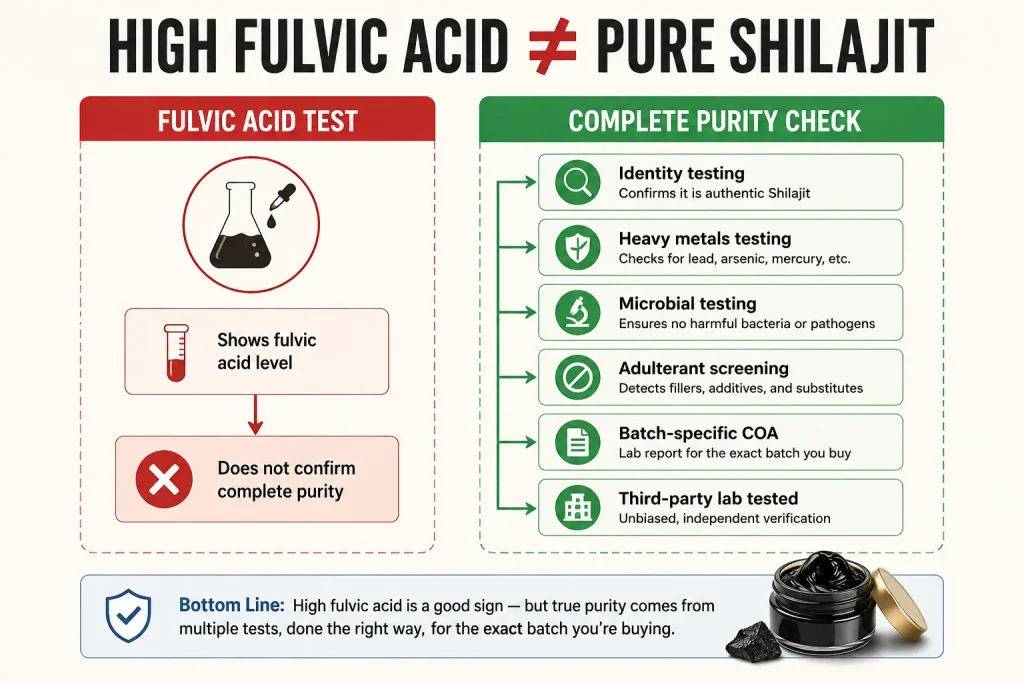
Why the fulvic acid test alone isn’t enough
Fulvic acid is measured because it’s the main marker of shilajit’s bioactive content. Independent testing groups have found fulvic acid levels in commercial products ranging from under 7 mg to over 2,200 mg per serving, a gap wide enough to make the number nearly meaningless on its own.
Standard gravimetric and colorimetric methods for fulvic acid can’t tell it apart from dextrin, maltodextrin, or similar carbohydrate fillers. These additives behave like fulvic acid under the same test conditions. A sample cut with dextrin can report a fulvic acid value that looks equal to or higher than genuine resin, while the real mineral and bioactive content sits well below what the label claims.
That’s the loophole that adulteration relies on: the certificate looks clean, the number looks good, and the product still isn’t what it says it is.
The additives to know about
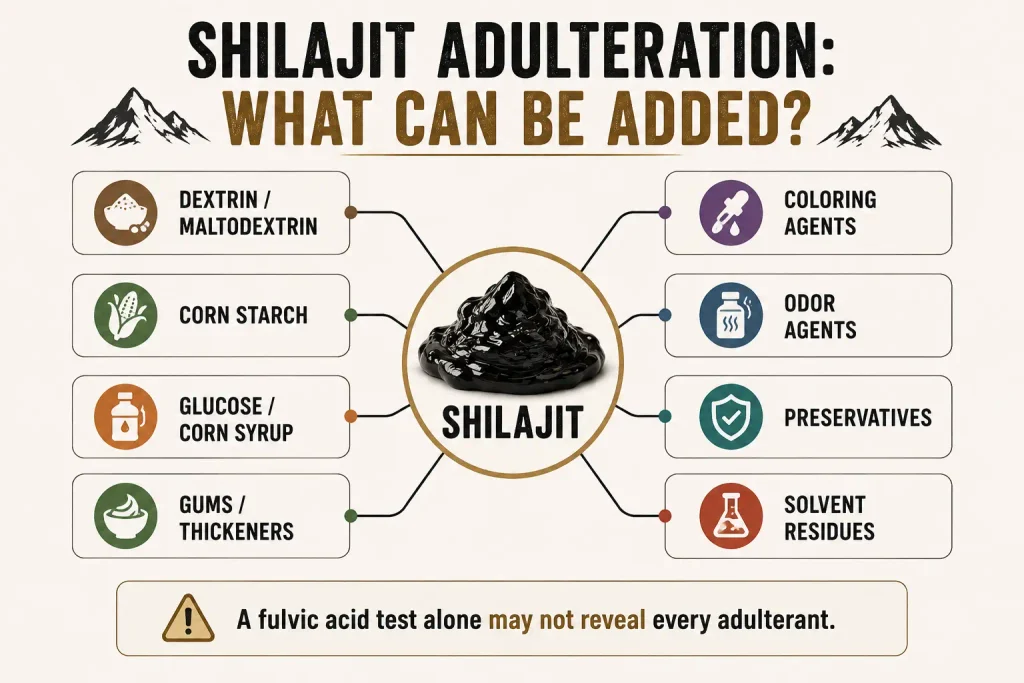
Adulteration in shilajit usually isn’t about swapping the product entirely. It’s about stretching a smaller amount of real resin further, or making a diluted batch look and taste like the real thing again.
- Dextrin, maltodextrin, corn starch: bulk out costly resin and thicken it back to a resin-like consistency. This is the main additive behind inflated fulvic acid readings.
- Glucose or corn syrup: added for the thick, thread-forming texture buyers associate with genuine resin, without adding any active compounds.
- Coloring agents (geru, jaggery, charcoal powder): mask poor-quality base material with a dark, “authentic” color.
- Added odor agents: recreate the earthy shilajit smell lost during aggressive processing or dilution. This is different from the traditional use of gomutra in shodhan (purification); here it’s applied afterward purely to fake the scent.
- Gums and artificial thickeners: adjust viscosity so the material behaves like resin, which throws off solubility and dosing accuracy.
- Preservatives (boric acid, sodium benzoate, potassium sorbate): extend shelf life on improperly processed material, often without disclosure on the label.
- Solvent residues, including methanol: left over from cheap, aggressive extraction methods, and a genuine safety concern if not tested for.
None of these show up on a basic fulvic acid test. They show up on identity testing, solvent-residue screening, and heavy metal and microbial panels.
Heavy metals are a separate, older problem
Shilajit forms over centuries in mineral-rich rock, which means trace metals are part of its natural chemistry. That’s not automatically dangerous, but it does mean testing matters more here than with most supplements.
A widely cited review of heavy metals in traditional Indian remedies found that in one dataset, 64% of shilajit samples collected in India contained significant lead, alongside notable rates of mercury, arsenic, and cadmium. More recent work has also flagged thallium as an under-tested contaminant in commercial shilajit, since most COAs check the standard four metals (lead, mercury, arsenic, cadmium) but skip it entirely.
The WHO’s guidance for herbal products sets reference limits around 10 ppm for lead and arsenic, 1 ppm for mercury, and 0.2 to 0.3 ppm for cadmium. A trustworthy shilajit product should test well under these numbers, using ICP-MS through an accredited third-party lab rather than an in-house method alone. If a supplier can’t produce that data per batch, that’s the first red flag, not the fulvic acid percentage.
Microbial safety gets skipped more than it should
Shilajit’s mineral resin is naturally low in moisture, which slows microbial growth, but it isn’t sterile. Raw material harvested from rock crevices and processed in humid, high-altitude conditions can pick up aerobic bacteria, yeast, and mold before it ever reaches a lab.
A complete safety panel checks total aerobic microbial count, yeast and mold count, and specific pathogens: E. coli, Salmonella, and Staphylococcus aureus. This matters more for shilajit than for many botanicals because it’s often taken daily, in small doses, over long periods, which gives any contamination more chances to matter.
If a certificate of analysis only reports fulvic acid and heavy metals, ask for the microbial data separately. It’s a routine test, so there’s rarely a good reason it’s missing.
Reading a certificate of analysis without getting misled
A shilajit COA is only useful if it actually maps to what you’re being sold. A few things worth checking before trusting the number on the front:
- Batch number and date. A COA should match the batch you’re buying, not a generic report reused across shipments.
- Loss on drying. This tells you how much of the product is water versus solid material. A value far from 15 to 20% can mean the resin is over-dried or under-processed.
- Identity confirmation, separate from the fulvic acid percentage, ideally by a method that distinguishes fulvic acid from carbohydrate mimics rather than one that measures both the same way.
- Solubility in water. Genuine purified shilajit dissolves almost completely. Visible residue after mixing in water is a sign of filler content or incomplete processing.
- Third-party lab name, not just “tested” with no lab identified. NABL-accredited labs in India, or an equivalent accreditation elsewhere, add a layer of accountability the manufacturer’s in-house numbers don’t have.
None of these checks require lab equipment. They require reading past the headline fulvic acid number to the rest of the report.
What genuine shilajit is actually used for
Traditional and early clinical use of shilajit centers on a few consistent claims: general vitality and stamina, support for muscle recovery, and a role as a mineral and nutrient carrier through fulvic acid’s chelating action. A small clinical trial published in Andrologia found purified shilajit associated with increased testosterone levels in healthy men over 90 days, though the sample size was modest and larger trials are still needed. Preclinical research has also looked at fulvic acid’s antioxidant and anti-inflammatory activity, including early work on tau protein aggregation relevant to neurodegenerative research, but this remains lab-stage evidence, not a clinical claim.
The gap between traditional reputation and rigorous modern testing is exactly why purity verification matters. A compound with this much geological and biological complexity is hard to standardize, and that complexity is what adulteration hides behind.
Resources and studies referenced
- Phytochemical Analysis (2019) — study on synthetic resin, gum, and starch adulteration in commercial shilajit samples.
- ConsumerLab.com (2023) — independent purity testing of commercial shilajit supplements.
- Ernst E. “Heavy metals in traditional Indian remedies.” European Journal of Clinical Pharmacology, and related systematic reviews on heavy metal content in shilajit samples from India and Pakistan.
- World Health Organization — Guidelines for Assessing Quality of Herbal Medicines with Reference to Contaminants and Residues.
- Biswas TK, et al. “Clinical evaluation of purified Shilajit on testosterone levels in healthy volunteers.” Andrologia.
- Carrasco-Gallardo C, et al. “Shilajit: A Natural Phytocomplex with Potential Procognitive Activity.” International Journal of Alzheimer’s Disease (PMC3296184).
- Agarwal SP, et al. “Shilajit: a review.” Phytotherapy Research, 2007.
- Quantifying thallium in Shilajit and its supplements, BMC Chemistry, 2025.
This article is for general information and doesn’t replace medical advice. Talk to a healthcare provider before starting any new supplement, especially if you’re pregnant, nursing, or managing an existing health condition.

Hi, I’m Emily Thomson, a wellness researcher and the voice behind Find Shilajit. I have explored and tested over 30 types of Shilajit from brands around the world, so you don’t have to. After experiencing its potential benefits firsthand, I became interested in learning more about Shilajit and began researching products, analyzing reviews across major e-commerce platforms, and creating clear, helpful content.
Many of the articles I publish are medically reviewed by a licensed practitioner to help ensure the information is accurate, safe, and genuinely useful, not just good-sounding.
Here, you’ll find research-based insights, honest reviews, and straightforward product comparisons. Based in Denver, USA, my mission is simple: to share authentic and trustworthy Shilajit knowledge with readers worldwide.