 By
ByI’ve had shilajit jars go rock-hard in a Denver kitchen cabinet within four months. I’ve also had a jar from Nepal that a colleague sent me to sit untouched in a cool closet for almost three years and still pull into a soft, sticky strand when I tested it. Same substance, wildly different outcomes.
So the honest answer to “does shilajit expire” is: not the way milk or bread does, but it absolutely degrades, and the speed depends almost entirely on how you store it and what form you bought.
Below is everything I’ve learned testing resin, powder, liquid drops, and capsules from a dozen brands over the past few years, plus the storage mistakes that wreck a good jar the fastest.
Quick answer
Unopened pure resin stays potent for 3 to 5 years if it’s sealed and kept cool. Once you open it, use it within 6 to 12 months for the best potency, though it won’t harm you for longer than that as long as it hasn’t taken on moisture or mold. Powder, capsules, and liquid drops degrade faster, usually within 1 to 2 years, because they’re more exposed to air and moisture during processing.
Does shilajit actually expire?
Raw shilajit forms over centuries inside Himalayan rock as plant matter breaks down under pressure and heat. Left in the mountain, it’s stable almost indefinitely.
Once it’s purified and put in a jar, that stability drops fast. Purification strips out a lot of the mineral matrix that protected it in the rock, so a bottled jar starts reacting with heat, light, moisture, and oxygen the moment it’s sealed.
That means shilajit doesn’t spoil the way food does. It doesn’t grow visibly rancid overnight. It loses potency first, quietly, long before it looks or smells different. By the time you can tell something’s wrong just by looking at it, you’ve usually already lost a meaningful chunk of the fulvic acid and minerals you paid for.
Shelf life by form: resin vs powder vs liquid vs capsules
| Form | Unopened shelf life | After opening | Main risk |
| Pure resin (jar) | 3 to 5 years | 6 to 12 months for peak potency, up to 2 to 3 years still usable | Moisture absorption, oxidation |
| Solid tablets | 2 to 3 years | 1 to 2 years | Surface oxidation |
| Powder | 1 to 2 years | 6 to 9 months | Moisture uptake, high heat during drying |
| Capsules | 1 to 2 years | 12 to 18 months | Shell breakdown, interaction with fill |
| Liquid drops | 1 to 2 years | 3 to 6 months | Microbial growth once opened |
Resin wins because it’s the least processed and has the smallest surface area exposed to air relative to its volume. Powder and liquid lose the fight because both processing methods (drying and dissolving) strip away the natural protection resin still has.
Also Read: Shilajit-resin-vs-powder-vs-capsules-vs-gummies-whats-right-for-you
How does shilajit’s shelf life compare to other Ayurvedic supplements?
This is worth knowing if shilajit isn’t the only thing in your cabinet. Compared to most other Ayurvedic staples, shilajit resin is actually one of the more stable products you’ll own:
- Chyawanprash contains sugars, honey, and herbal extracts, which makes it far more prone to fermentation and spoilage than shilajit’s low-moisture resin.
- Ashwagandha powder is highly moisture-sensitive and degrades faster than shilajit powder in the same storage conditions, since it lacks shilajit’s dense mineral matrix.
- Herbal syrups rely heavily on added preservatives to stay stable at all; without them, most have a shorter practical shelf life than even processed shilajit forms like capsules or drops.
Shilajit resin’s advantage comes down to the same thing that makes it stable in the mountain: low water content and a mineral-dense structure that gives microbes and oxidation less to work with. That advantage disappears once you move to powder, capsules, or liquid, which is why the form you buy matters more than the “shilajit” label alone.
Does raw, unprocessed shilajit expire differently than purified resin?
Yes, and this is where a lot of buyers get confused. Raw shilajit straight off the rock face still has soil, plant fiber, and mineral debris mixed in. It’s actually more stable in that state because those impurities buffer it against oxidation. But raw shilajit isn’t safe to consume without purification (Shodhana in Ayurvedic terms), since it can carry heavy metals, mold spores, and organic contaminants at unsafe concentrations.
So “does raw shilajit expire” has two answers depending on what you mean. As a mountain-sourced raw lump, it’s extremely stable for years. As a consumer product labeled “raw” or “wild-harvested” that hasn’t gone through real purification, treat it with more caution, not less. Unpurified raw shilajit sold direct-to-consumer is one of the more common sources of contamination complaints I’ve seen in supplement forums.
Does bottled or liquid shilajit expire faster?
Yes, noticeably. Liquid shilajit drops are shilajit resin dissolved into a water or glycerin base, and that liquid environment is exactly what mold and bacteria need to grow. Most liquid products carry a 1 to 2 year shelf life unopened and drop to 3 to 6 months once you break the seal, especially if there’s no preservative listed on the label.
If your liquid shilajit smells sour, looks cloudy where it used to be clear, or has any visible particles floating that weren’t there before, don’t finish the bottle. That’s a different failure mode than resin going hard. It’s closer to how a probiotic drink goes off.
Can hardened resin be revived?
Often, yes — and this is worth knowing before you throw out a jar that just looks worse than it actually is. If your resin has gone rock-hard because it dried out (not because it’s contaminated), you can usually bring it back by placing the sealed jar in a bowl of warm water for a few minutes, or by adding a couple of drops of plain water directly into the jar and letting it sit.
The key word is sealed and dried out. This trick restores moisture the resin lost, which is a different problem from moisture the resin absorbed. If your jar has gone runny, moldy, or smells off, this isn’t a fix — that’s a different failure mode entirely, and the guidance in “7 signs your shilajit has gone bad” below applies instead. Hardness on its own, with no smell or texture change beyond rigidity, is usually just dehydration, not degradation.
What’s on your label (and why the “expiration date” is often misleading)
US supplement labels aren’t required to carry a true expiration date the way pharmaceuticals are. Most shilajit brands print a “best by” date instead, which is a manufacturer’s estimate of peak potency, not a safety cutoff. The FDA doesn’t mandate expiration testing for dietary supplements the way it does for drugs, so that date reflects the brand’s internal stability testing (if they did any) more than a hard biological limit.
Worth knowing plainly: there’s no industry-wide standard for how shilajit brands calculate this date at all. Some print 12 months, some print 5 years, for products that are chemically similar. When you see wildly different shelf-life claims on two jars of what’s basically the same resin, that’s not necessarily one brand being wrong — it’s a sign that “expiration date” on shilajit packaging is closer to a marketing estimate than a lab-verified number across the industry.
A few things worth checking on your jar or box:
- Lot number: lets you trace the batch if you ever need to report an issue.
- Manufacture date vs best-by date: some brands print both, some only print one. If you only see a best-by date, subtract roughly 2 to 3 years to estimate when it was made.
- Storage instructions on the label: “store in a cool, dry place” is standard, but a few brands specify a temperature range. Follow theirs over generic advice if it’s listed.
Brands that package resin in individual gel sachets, like Cymbiotika’s stick format, handle this differently than jar resin. Each sachet stays sealed until you tear it open, so the degradation risk sits almost entirely in how you store the box before use, not in repeated air exposure from opening and closing a jar. Jar-based brands (Kapiva, Upakarma, Himalaya, and most traditional Himalayan resin sellers) put more of that risk on you, since every scoop lets in fresh air and whatever humidity is in your kitchen that day.
The 4 things that ruin a good jar of shilajit
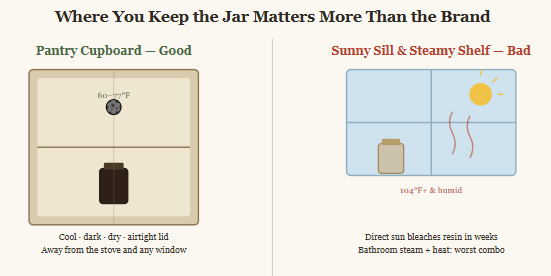
Heat. Above 104°F (40°C), the compounds that let fulvic acid bind and carry minerals start breaking down. Above 140°F (60°C), lab estimates put the drop in mineral delivery at up to 30%. A car dashboard in July or a shelf next to your stove will get there fast.
Light. UV light bleaches resin from the inside out if it’s stored in clear glass. I’ve watched a jar on a sunlit windowsill visibly lighten in color within 5 to 6 weeks. Amber, cobalt, or violet glass blocks this; clear glass doesn’t.
Moisture. Shilajit pulls moisture out of the air on its own, which is part of why it works so well as a mineral carrier in your body. In a jar, that same property invites mold, particularly Aspergillus species that produce mycotoxins.
Oxygen. Every time you open the lid, oxygen reacts with the aromatic compounds that give resin its smell and some of its bioactivity. Frequent opening and closing does more damage over a year than most people expect.
7 signs your shilajit has gone bad
- It won’t soften at all. Warm resin between your fingers for 30 seconds. If it stays completely rigid, it’s lost too much moisture and structural integrity to dissolve properly anymore. (If this is the only sign present, see “Can hardened resin be revived?” above before writing the jar off.)
- It’s runny at room temperature. Good resin firms up when cool and softens with warmth, but it shouldn’t flow like syrup sitting on your counter. That usually means excess moisture uptake or, less often, a filler-adulterated product to begin with.
- The smell has turned sour or chemical. Fresh resin smells earthy and mineral, almost smoky. Sour or fermented means oxidized fats within the organic matter. A petroleum or rubber smell means the product likely wasn’t pure from the start.
- The color has faded to gray or gone blotchy. Rich dark brown to black is normal. Fading usually tracks with a real drop in fulvic acid content, and blotches can signal localized contamination.
- It fails the water test. Drop a pea-sized amount into warm water and stir for 5 to 10 minutes. It should dissolve almost completely with no residue. Gritty sediment or an oily film on top both point to degradation or adulteration.
- The taste has shifted. This one gets skipped in most guides, but it’s useful. Fresh resin tastes bitter and mineral-heavy, not unpleasant once you’re used to it. A metallic, chemical, or flat taste that wasn’t there before usually shows up right around the same time the smell changes, and together they’re a reliable pair.
- You see any fuzzy growth. No exceptions here. Any visible mold, in any color, on the resin or the jar walls, means the whole jar goes in the trash. Don’t scoop around it.
Mold or just minerals? The 10-second test
Shilajit naturally carries over 80 trace minerals, and some of them migrate to the surface over time, especially with temperature swings. That shows up as a flat, powdery white or gray coating, and it looks alarming even though it’s harmless.
Here’s how to tell the difference: put one small drop of water directly on the spot. If it dissolves right away and cleanly, that’s mineral bloom and your resin is fine. If it stays fuzzy, holds its shape, or feels fibrous when wet, that’s mold. Toss the jar.
This single test has probably saved me from throwing out two perfectly good jars, and it’s the one tip from my testing I wish every brand printed on the label.
Who needs to be extra careful with storage
Storage advice is the same for everyone, but the stakes aren’t. A few groups should be stricter about following it than the average buyer:
- People in humid climates. If you live somewhere with regular high humidity, your jar is fighting moisture uptake constantly, not just when you open the lid. Consider refrigeration even if it’s not strictly necessary elsewhere.
- Frequent travelers. A jar that lives in a bag, hotel room, or car for stretches of the trip sees far more temperature swings than one sitting on a shelf at home. If you travel with shilajit often, decant a small travel amount rather than carrying your main jar.
- Bulk buyers. Buying a large jar to save money only pays off if you can actually store it well for the length of time it’ll take you to finish it. If you buy in bulk, the decanting approach below isn’t optional, it’s the only way to protect most of your supply.
- Long-term daily users. If shilajit is a permanent part of your routine rather than an occasional supplement, the cumulative effect of repeated jar-opening and small storage mistakes adds up over a year in a way it doesn’t for occasional use.
What actually happens if you use degraded shilajit
Three separate risks, and they’re not equal.
You lose the benefit. Once fulvic acid’s molecular structure breaks down, it can’t carry minerals or antioxidants into your cells anymore. You’re taking an inert lump that does effectively nothing.
Heavy metals can concentrate. As moisture evaporates out of a poorly sealed jar over time, whatever trace heavy metals were present (lead and arsenic, mainly, in lower-quality or poorly purified batches) become more concentrated per dose than they were when fresh. This is a bigger issue with cheaper, undertested products than with lab-verified ones.
Also Read: Heavy Metals in Shilajit: What the Testing Actually Shows.
Mold means mycotoxins. If mold has grown, you’re not just risking an upset stomach. Aspergillus and similar molds produce mycotoxins that are linked to allergic reactions, respiratory issues, and with repeated exposure, more serious organ effects. This is the one outcome on this list that’s worth taking seriously rather than shrugging off.
Storing shilajit so it actually lasts
Keep it at 60 to 77°F (15 to 25°C), away from light, in an airtight dark glass container. A pantry shelf works. A bathroom cabinet does not; the heat and humidity from showers is close to the worst combination possible.
Refrigeration works, with one rule. Cold storage (around 39 to 45°F) can stretch shelf life to 4 or 5 years, but never open a jar straight out of the fridge. Let it sit sealed at room temperature for 15 to 20 minutes first, or condensation forms inside the lid the second it hits warm air, and that moisture is exactly what triggers mold.
Traveling with shilajit. If you’re flying, resin handles checked luggage and TSA screening fine since it’s solid, but a hot car trunk on a layover or a sunny rental car dashboard will do more damage in an afternoon than a year on your shelf at home. I cover packing specifics, including how resin behaves in cargo hold pressure and temperature, in [Can You Travel With Shilajit? What to Know Before You Fly].
Use dry utensils only. A single damp spoon can introduce enough moisture to start mold growth within days. Stainless steel, wood, or silicone, always dry.
Decant if you buy in bulk. Split off a month’s supply into a small dark jar for daily use and keep the main jar sealed and untouched. This keeps your bulk supply from getting hit with fresh oxygen every single day.
How I actually test a jar before I trust it
For any resin I review on this site, I run the same three checks before writing anything: the water solubility test, a smell check against a known-fresh reference jar I keep in cold storage specifically for comparison, and a texture check at three temperatures (fridge-cold, room temp, and warmed between fingers). A jar that passes all three at the two-month mark and still passes at the six-month mark tells me more about a brand’s actual purification and packaging quality than anything on their marketing page.
This is also why I’m skeptical of brands that don’t disclose a lot number or third-party lab report. If a company won’t tell you when a batch was made, you can’t judge whether what you’re holding is fresh or two years past its useful window.
Buying shilajit that’s built to last
Storage only protects a product that was good to begin with. A few things worth checking before you buy, not after:
- A named purification process, not just “purified” with no detail
- A current third-party (NABL, ISO, or equivalent) lab report showing fulvic acid percentage and heavy metal screening
- Source altitude disclosed, generally above 16,000 feet for the Himalayan resin most brands reference
- Dark, airtight glass packaging, not clear glass or plastic
If a brand is vague on all four, assume the shelf life claims on the label are marketing copy, not lab data.
Key takeaways
- Pure resin degrades gradually, not overnight, and loses potency well before it looks or smells obviously bad
- Unopened resin lasts 3 to 5 years; opened, aim to use it within 6 to 12 months for full strength
- Powder, capsules, and liquid drops all degrade faster than resin, usually within 1 to 2 years
- Shilajit resin is more stable than most other Ayurvedic staples like chyawanprash, ashwagandha powder, or herbal syrups, thanks to its low moisture content
- Heat, light, moisture, and oxygen are the four things doing the damage, in roughly that order of severity
- Rock-hard resin with no smell or texture change beyond rigidity can often be revived with warm water; runny, sour, or moldy resin cannot
- There’s no industry standard for how shilajit brands set expiration dates, so treat any printed date as an estimate, not a lab-verified cutoff
- The water drop test tells mineral bloom (harmless) from mold (discard) in 10 seconds
- Any visible mold means the whole jar goes, no exceptions
- Refrigeration extends shelf life, but only if you let the jar warm up sealed before opening it
FAQ
Does shilajit resin expire if it’s never opened?
Yes, though slowly. Sealed resin stored cool and dark stays fully potent for 3 to 5 years and can last longer with refrigeration, but it isn’t indefinite the way raw, unpurified shilajit inside a rock face is.
Does pure shilajit expire faster than blended or processed products?
Usually the opposite. Pure, minimally processed resin tends to outlast powders, capsules, and liquid drops because those forms go through more processing steps that expose the material to heat, air, and moisture.
Can I still use shilajit after the best-by date on the label?
Often, yes, as long as it passes the water test, still has a normal smell and texture, and shows no mold. The best-by date is a potency estimate, not a hard safety cutoff, for most resin products.
Does shilajit lose its benefits even if it doesn’t look bad?
Yes. Potency loss happens before visible signs of degradation. A jar that still looks and smells fine after 2 years of poor storage may already be delivering meaningfully less fulvic acid than a fresh batch.
Is it safe to smell-test shilajit to check if it’s gone bad?
Yes, and it’s one of the most reliable checks you have. Fresh resin smells earthy and slightly smoky. Sour, fermented, or chemical smells are reliable warning signs.
Does refrigerating shilajit change its texture?
Yes, cold resin firms up and can become quite hard, which is normal. It should still soften within 30 seconds of warming between your fingers. If it stays rigid after warming, that’s a sign of degradation, not just cold.
How do I dispose of shilajit that’s gone bad?
Seal the jar and put it in regular household trash. Don’t rinse resin or liquid drops down a drain, and don’t try to salvage part of a moldy jar.
Does BetterAlt Shilajit Expire?
Yes. BetterAlt Shilajit has an expiration date, so always check the label and use it before the printed expiry.
Does Cymbiotika Shilajit Expire?
Yes. Cymbiotika Shilajit expires and should be used before the expiration date for the best quality.
Does Himalayan Shilajit Expire?
Yes. Himalayan Shilajit has an expiration date, even though pure resin typically has a long shelf life.
Does Kapiva Shilajit Expire?
Yes. Kapiva Shilajit expires. Store it properly and follow the expiration date on the packaging.
Does Upakarma Shilajit Expire?
Yes. Upakarma Shilajit expires, so use it before the printed expiry date for the best potency and quality.
Also Read: Salam Panja vs Shilajit: What’s the Real Difference?
Scientific Resources and Studies
- FDA Regulatory Framework: Dietary Supplement vs. Drug GMP Requirements — The regulatory source behind the “expiration dates are estimates, not safety cutoffs” claim in this article. Confirms there’s no FDA requirement for expiration or stability testing on dietary supplements under 21 CFR Part 111, unlike pharmaceuticals. Explains exactly why shilajit brands’ “best by” dates vary so much in reliability.
- CPSC Statement on Mold and Mycotoxins Health Effects — A government consumer-safety review of documented health effects from Aspergillus and related mold exposure, including respiratory impairment and allergic sensitization. Supports the “mold means mycotoxins, take it seriously” section without overstating shilajit-specific risk, since this is general mold science, not a shilajit trial.
- ConsumerLab Independent Testing of Shilajit Supplements — Direct lab testing of eight commercial shilajit products for fulvic acid content and heavy metal levels. The best available evidence for the claim that quality and contamination vary significantly by brand, which is central to the “buying shilajit that’s built to last” section.
- Hazardous or Advantageous: Heavy Metals and Humic Substances in Shilajit — A review compiling heavy metal data across shilajit studies and discussing how humic/fulvic compounds can bind and partially detoxify metals. Relevant background for the “heavy metals can concentrate as moisture evaporates” claim, though it doesn’t test degraded or expired product specifically.
- Chemical Analysis of Native Himalayan Shilajit: An Evaluation of an Ayurvedic Formulation — Establishes the baseline mineral and organic compound profile of fresh, unprocessed resin, the reference point needed to even talk about what’s being “lost” as shilajit degrades. Doesn’t test aged or stored samples directly.
- Stability and Degradation of Caffeoylquinic Acids Under Different Storage Conditions — Not a shilajit study, but the closest available analog: tracks how heat and light degrade plant-derived bioactive acids over time using HPLC analysis. Supports the general mechanism behind “heat and light are the two biggest degradation drivers” without claiming shilajit’s fulvic acid behaves identically.
- Characterization of Aromatic Structures in Humic and Fulvic Acids — Foundational chemistry research on how fulvic and humic acid molecules oxidize and break down structurally. Useful for readers who want the “why” behind fulvic acid losing potency through oxidation, though it’s chemistry-focused rather than a consumer-product shelf-life study.
Disclaimer
This article is for informational and educational purposes only and is not intended to provide medical advice, diagnose or treat any health condition, or replace guidance from a qualified healthcare professional. Shilajit is a dietary supplement, and its effects, safety, and suitability may vary from person to person. Consult a licensed healthcare provider before using Shilajit or any new supplement, particularly if you are pregnant, breastfeeding, taking medication, or have an existing medical condition. Do not use this information as a substitute for professional medical advice.