 By
ByBuying authentic shilajit isn’t just about choosing a trusted brand. It’s also about understanding the Certificate of Analysis (COA) that comes with it. A COA is one of the few documents that can help you verify whether a shilajit supplement has been tested for purity, contaminants, and quality before it reaches your hands.
Unfortunately, many buyers either never ask for a COA or don’t know how to read one. They may only glance at words like “Pass” or “Tested” without understanding what the report actually says. That’s a missed opportunity because a properly prepared COA can reveal far more than whether a product simply passed laboratory testing.
If you’re discussing shilajit with your doctor, bringing a recent COA can also help them better evaluate the product you’re taking. It provides objective laboratory data rather than relying only on marketing claims or product labels.
In this guide, you’ll learn how to read a shilajit COA, identify warning signs, understand heavy metal reports, and recognize what separates a trustworthy laboratory report from one that deserves closer scrutiny.
What Is a Shilajit COA?
A Certificate of Analysis (COA) is an official laboratory document that summarizes the results of quality testing performed on a specific batch of shilajit. Reputable manufacturers typically send samples to an independent laboratory where specialists analyze the product using validated testing methods.
Unlike marketing material, a COA contains measurable laboratory data. It helps confirm whether the product matches its identity, meets quality specifications, and falls within acceptable safety limits for contaminants.
A complete shilajit COA usually includes:
- Product identification
- Batch or lot number
- Manufacturing or sampling date
- Laboratory testing date
- Identity confirmation
- Heavy metal testing
- Microbial testing
- Moisture content
- Ash values
- Fulvic acid or humic substance analysis (when performed)
- Laboratory name and analyst approval
Keep in mind that not every laboratory tests the same parameters. Some reports are far more comprehensive than others.
Why a COA Matters Before You Buy Shilajit
Shilajit forms naturally in mountain environments where minerals accumulate over hundreds or even thousands of years. While this contributes to its unique composition, it also means raw shilajit may naturally contain unwanted contaminants if it isn’t properly purified.
A recent COA provides evidence that a manufacturer has tested the finished product rather than simply making quality claims.
Reading the COA allows you to verify:
- The supplement was tested by an independent laboratory.
- Heavy metals fall within acceptable limits.
- Harmful bacteria and molds were screened.
- The report belongs to the same batch you’re purchasing.
- The testing was performed recently.
Think of a COA as a quality control report rather than an advertising brochure. The more transparent the manufacturer is about testing, the easier it becomes to evaluate the product objectively.
How to Verify That a Shilajit COA Is Genuine
One mistake many consumers make is assuming every PDF labeled “Certificate of Analysis” is authentic.
Before reviewing laboratory values, confirm that the document itself appears legitimate.
Look for these details:
Matching Batch Number
The batch or lot number on the COA should match the number printed on your product packaging.
If they don’t match, the report may belong to a different production batch.
Recent Testing Date
Laboratory reports should be reasonably current.
A manufacturer using a five-year-old COA for today’s production batches raises questions about ongoing quality control.
Third-Party Laboratory
The report should clearly identify the testing laboratory.
Independent laboratories generally provide more confidence than reports generated solely by the manufacturer.
Laboratory Accreditation
Many reputable testing laboratories operate under internationally recognized quality systems such as ISO/IEC 17025.
Accreditation doesn’t guarantee product quality, but it demonstrates that the laboratory follows recognized testing standards.
Analyst Approval
Most professional COAs include a reviewer, laboratory signature, electronic approval, or authorized sign-off confirming the report has been reviewed before release.
Contact Information
A legitimate laboratory report usually includes the laboratory’s name, address, or contact information.
The more transparent the documentation, the easier it is to verify its authenticity.
Why Doctors Ask About Heavy Metal Testing
One of the first questions healthcare professionals may ask about a mineral-based supplement is whether it has been tested for heavy metals.
This isn’t because shilajit is inherently unsafe. It’s because natural products collected from geological environments can accumulate trace metals from surrounding rock formations.
Without purification and quality testing, unwanted contaminants could remain in the finished product.
Comprehensive heavy metal testing helps identify elements such as:
- Lead (Pb)
- Arsenic (As)
- Cadmium (Cd)
- Mercury (Hg)
A COA doesn’t simply indicate whether these metals were detected—it reports the measured concentrations so they can be compared with recognized quality standards.
For this reason, heavy metal testing is one of the most important sections of any shilajit COA and one your doctor is likely to review first.
Sample Information: The First Section to Check
Before reading laboratory values, verify that the sample information is complete.
Most COAs begin with basic identification details.
Check for:
- Product name
- Batch number
- Sample identification
- Date received
- Date tested
- Date issued
These details confirm exactly which sample underwent laboratory analysis.
If a COA contains no batch number or testing date, it’s difficult to know whether the report actually belongs to the product you’re considering.
Laboratory Testing Methods
A professional COA should also explain how the sample was analyzed.
Different tests require different laboratory instruments.
For heavy metals, laboratories commonly use:
ICP-MS
Inductively Coupled Plasma Mass Spectrometry is one of the most sensitive techniques available for measuring trace metals in dietary supplements.
ICP-OES
Some laboratories use Inductively Coupled Plasma Optical Emission Spectroscopy, another validated method for elemental analysis.
Atomic Absorption Spectroscopy (AAS)
Certain laboratories may also use Atomic Absorption Spectroscopy for measuring specific metals.
The testing method matters because it determines how accurately the laboratory can detect extremely small concentrations of contaminants.
Later in the report, you’ll often see two additional terms:
LOD (Limit of Detection) — the smallest amount a test can detect.
LOQ (Limit of Quantification) — the smallest amount the laboratory can measure with confidence.
Lower detection limits generally indicate more sensitive analytical testing, allowing laboratories to identify contaminants even at very low concentrations.
Understanding the Most Important COA Parameters
Many people focus only on heavy metal results, but a quality COA contains much more information. Understanding each parameter helps you determine whether the product has been properly tested and whether it meets the manufacturer’s quality specifications.
Appearance
This section describes the physical characteristics of the sample, including its color, texture, and consistency.
A typical purified shilajit resin is usually reported as a dark brown to black resin or semi-solid mass. While appearance alone doesn’t prove authenticity, it helps confirm the sample matches the expected product.
Identity Test
Identity testing confirms the laboratory received the correct material.
Depending on the laboratory, this may involve chemical fingerprinting, spectroscopic analysis, or other analytical methods to verify that the sample is consistent with shilajit.
Fulvic Acid
Fulvic acid is one of the best-known naturally occurring compounds found in shilajit.
Some manufacturers include fulvic acid percentages on their COAs, while others may not test for it at all.
Remember that a higher percentage doesn’t automatically mean a better product. The quality of purification, safety testing, and overall composition are just as important.
Humic Substances
Some reports also measure humic acid or total humic substances.
These compounds naturally occur during the decomposition of plant material and are considered part of shilajit’s complex chemical profile.
Moisture Content
Moisture indicates how much water remains in the finished product.
Excess moisture may shorten shelf life and increase the risk of microbial growth if manufacturing practices are poor.
Ash Content
Ash represents the mineral residue remaining after the sample is heated to very high temperatures.
Because shilajit naturally contains minerals, some ash is expected. Laboratories compare the results against the manufacturer’s quality specifications.
Acid Insoluble Ash
This test measures mineral material that does not dissolve in acid.
Higher values may suggest contamination from sand, soil, or other inorganic particles collected during harvesting.
Heavy Metal Results: The Most Important Safety Section
Heavy metal testing is often the first section healthcare professionals review.
Natural products collected from mountain environments can contain trace amounts of metals depending on local geology. Proper purification and quality testing help ensure those levels remain within accepted safety limits.
Most COAs report the following elements:
Lead (Pb)
Lead is one of the most closely monitored contaminants because long-term exposure may affect the nervous system, kidneys, and cardiovascular health.
Arsenic (As)
Laboratories usually report total arsenic.
Because inorganic arsenic is considered more toxic than organic forms, some advanced laboratories perform additional speciation testing when appropriate.
Cadmium (Cd)
Cadmium exposure over many years may affect kidney function and bone health, making it another routine screening parameter.
Mercury (Hg)
Mercury testing helps identify contamination that could affect neurological health if exposure becomes excessive over time.
Most laboratories report these values in parts per million (ppm) or parts per billion (ppb).
Rather than simply asking whether a metal was detected, compare the reported value with the laboratory’s specification or recognized quality standards.
Understanding “ND” on a COA
Many consumers assume “ND” means absolutely zero.
That’s not technically correct.
ND stands for Not Detected, meaning the laboratory did not detect that substance above its analytical detection limit.
For example:
Lead: ND (LOD = 0.02 ppm)
This means the laboratory could not detect lead above 0.02 ppm using its testing method.
That’s why reviewing the Limit of Detection (LOD) is just as important as looking at the reported result.
Other Contaminants Every COA Should Include
A high-quality COA doesn’t stop with heavy metals.
Microbiological and contaminant testing provide additional reassurance that the finished product is safe for consumption.
Look for results covering:
Total Plate Count
Measures the total number of microorganisms present in the sample.
Lower counts generally indicate better manufacturing hygiene.
Yeast and Mold
These tests help identify fungal contamination that could affect product quality or safety.
Salmonella
Salmonella should be absent from dietary supplements intended for human consumption.
Escherichia coli (E. coli)
Testing confirms the product is free from this important indicator of bacterial contamination.
Mycotoxins
Some laboratories also screen for fungal toxins such as aflatoxins, especially in botanical ingredients.
Pesticide Residues
Although shilajit is not an agricultural crop, some manufacturers include pesticide screening as part of comprehensive quality assurance.
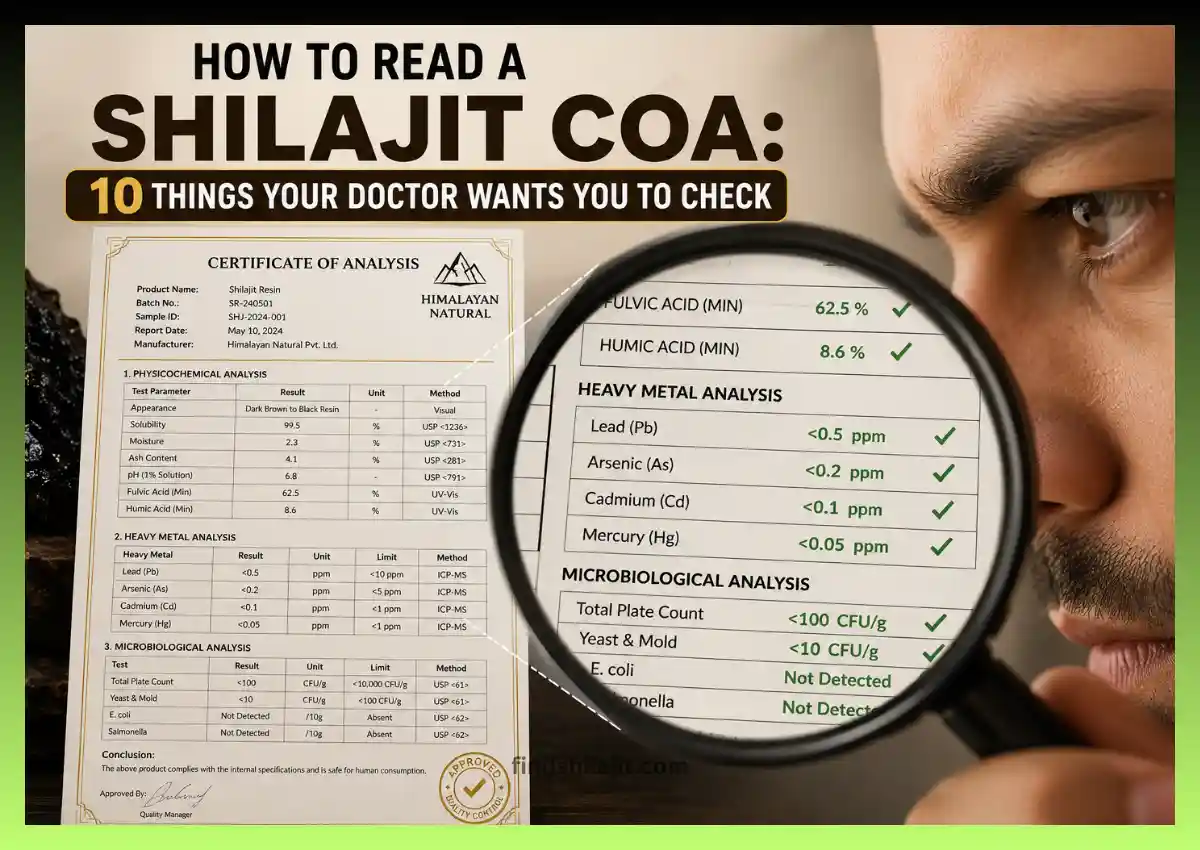
Real COA Walkthrough: Read a Shilajit Report Step by Step
When you first open a Certificate of Analysis, don’t jump straight to the word “Pass.”
Instead, review the report in a logical order.
| COA Section | Example | What It Means |
| Batch Number | SH260401 | Matches your product packaging |
| Testing Date | April 2026 | Confirms recent laboratory analysis |
| Lead | 0.08 ppm | Within laboratory specification |
| Mercury | ND | Not detected above the testing limit |
| Fulvic Acid | 54% | Naturally occurring fulvic compounds identified |
| Total Plate Count | Pass | Acceptable microbiological quality |
| Salmonella | Absent | No Salmonella detected |
Following the report from top to bottom helps you understand whether the document is complete and whether the laboratory evaluated all major quality parameters.
Red Flags That Should Make You Ask Questions
Not every missing value indicates a poor-quality supplement, but several warning signs deserve closer attention.
Be cautious if you notice:
- No batch or lot number.
- No laboratory name.
- Missing testing date.
- No heavy metal section.
- No microbiological testing.
- Missing testing methods.
- Extremely old COAs used for current products.
- Laboratory reports without analyst approval.
- Product labels that don’t match the batch number shown on the COA.
Any one of these issues doesn’t automatically mean the product is unsafe. However, the more information that’s missing, the harder it becomes to verify the supplement’s quality independently.
How to Read a Shilajit COA in Five Minutes
You don’t need a scientific background to review a Certificate of Analysis.
Follow this simple checklist:
- Confirm the batch number matches your product.
- Check that the testing date is recent.
- Verify the laboratory is independent.
- Review heavy metal results.
- Look for microbial testing.
- Check whether testing methods are listed.
- Confirm the report includes analyst approval.
- Compare the results with the manufacturer’s specifications.
Spending just a few minutes reviewing these sections can give you much greater confidence in the supplement you’re choosing and provide useful information to discuss with your healthcare provider if needed.
Questions Your Doctor May Ask Before You Take Shilajit
If you’re planning to take shilajit regularly, your doctor may ask a few questions before recommending it. These questions help determine whether the supplement is appropriate for your health history and whether additional monitoring is needed.
Your doctor may ask:
- Do you have kidney or liver disease?
- Are you pregnant or breastfeeding?
- Do you take blood pressure or diabetes medications?
- Have you ever had iron overload or hemochromatosis?
- Are you taking other herbal supplements?
- Have you reviewed the product’s Certificate of Analysis?
- Has the supplement been tested for heavy metals?
- How long have you been taking it?
Having a recent COA available during your appointment can help answer many of these questions and make it easier to evaluate the product objectively.
When Should You Avoid a Shilajit Supplement?
A COA helps verify product quality, but it doesn’t determine whether shilajit is appropriate for every individual.
Speak with your healthcare provider before using shilajit if you:
- Have chronic kidney disease.
- Have liver disease.
- Are pregnant or breastfeeding.
- Have an iron storage disorder such as hemochromatosis.
- Take prescription medications that require careful monitoring.
- Have an autoimmune condition and are unsure whether supplementation is appropriate.
A qualified healthcare professional can help determine whether shilajit fits your individual health needs.
Frequently Asked Questions
What is a Certificate of Analysis (COA)?
A Certificate of Analysis is a laboratory report that verifies the identity, purity, and safety of a specific production batch. It typically includes heavy metal testing, microbiological screening, and other quality parameters.
Why is a COA important for shilajit?
Shilajit is naturally collected from mountain environments where minerals accumulate over time. A COA confirms that the finished product has been tested for contaminants and meets the manufacturer’s quality specifications.
Should every shilajit product have a COA?
Reputable manufacturers usually provide a recent batch-specific COA or make one available upon request. If a company cannot provide laboratory documentation, it’s reasonable to ask why.
What does “ND” mean on a laboratory report?
ND stands for Not Detected, meaning the laboratory did not detect that substance above the method’s limit of detection.
Which heavy metals should be tested?
A comprehensive COA should normally include:
- Lead (Pb)
- Arsenic (As)
- Cadmium (Cd)
- Mercury (Hg)
Some laboratories may also report additional elements depending on their testing protocol.
Is fulvic acid the most important value on a COA?
Fulvic acid is an important naturally occurring component of shilajit, but it shouldn’t be viewed in isolation. A high-quality supplement should also demonstrate acceptable heavy metal results, microbiological safety, and proper purification.
How often should manufacturers test shilajit?
Quality-focused manufacturers generally perform testing on each production batch rather than relying on a single historical report.
Can a COA prove that shilajit is authentic?
A COA provides valuable evidence about quality and testing, but authenticity depends on several factors, including sourcing, purification, identity testing, and independent laboratory verification. Reviewing all sections of the report gives a more complete picture than focusing on a single result.
Final Verdict
A Certificate of Analysis is one of the most valuable tools for evaluating a shilajit supplement. Instead of relying on marketing claims, it allows you to review objective laboratory data about identity, purity, heavy metals, microbiological safety, and overall quality.
When reading a COA, start by confirming the batch number, testing date, and laboratory information. Then review the heavy metal results, microbiological testing, analytical methods, and any additional quality markers included in the report.
Remember that no single value determines whether a supplement is high quality. A trustworthy COA tells a complete story by showing that the product has been independently tested, properly documented, and evaluated using recognized laboratory methods.
If you’re unsure how to interpret a laboratory report, bring a copy of the COA to your healthcare provider. Reviewing the results together can help you make a more informed decision and choose a shilajit supplement backed by transparent quality testing rather than marketing claims alone.
Also Read:
Almonds vs Shilajit: Which Is Better?
Zeolite vs Shilajit: What’s the Difference?
References
- PubMed – Shilajit: A Natural Phytocomplex with Potential Procognitive Activity
- PubMed – Shilajit: A Panacea for High-Altitude Problems
- NIH Office of Dietary Supplements
- U.S. Food & Drug Administration – Dietary Supplements
- United States Pharmacopeia (USP)
- AOAC INTERNATIONAL
- National Center for Biotechnology Information (NCBI)
- International Organization for Standardization (ISO/IEC 17025)
Disclaimer
This article is for informational purposes only. Please consult a licensed healthcare provider before starting any new supplement, especially if you are pregnant, breastfeeding, or on medication.

Reviewed by: Dr. Natha Thomas, PhD (USA)
Nutrition and supplement research professional interested in nutritional science, dietary supplements, nutrient bioavailability, scientific literature, and how research findings are communicated to consumers.
View full profile →Medical review date: July 28, 2026