 By
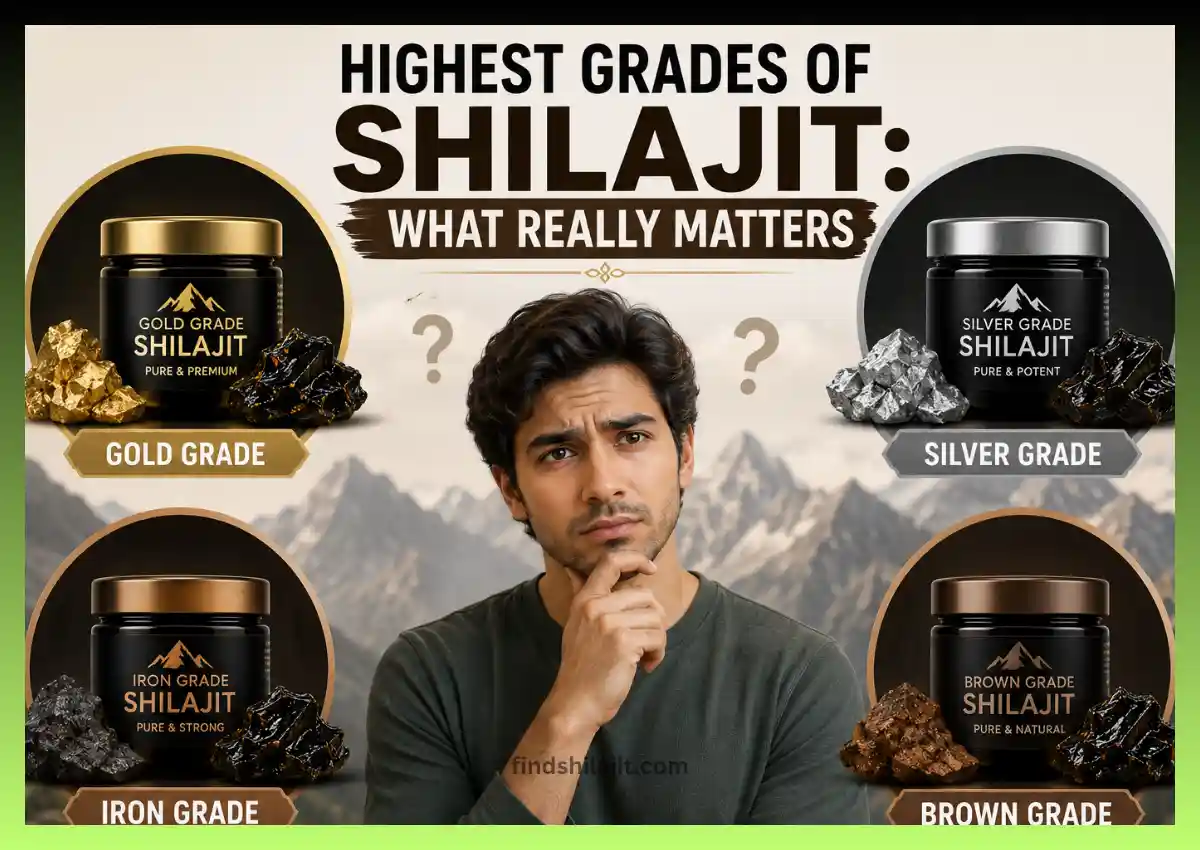
ByIf you’ve been researching shilajit, you’ve probably seen products labeled as Gold Grade, Silver Grade, Iron Grade, Brown Grade, or even Premium Grade A. These labels often make it seem like one type is automatically better than another.
The reality is more complicated.
Traditional Ayurveda does describe different types of shilajit, but many modern marketing terms don’t accurately reflect those ancient classifications. In fact, there is no internationally accepted grading system that ranks shilajit from lowest to highest quality.
That’s why understanding how shilajit is traditionally classified—and what actually determines quality today—is far more useful than relying on attractive product labels.
In this guide, you’ll learn what the traditional Shilajit grading system (Gold, Silver, Copper, and Iron) means, whether these grades are still relevant today, and what you should actually look for when choosing high-quality shilajit.
What Does “Highest Grade of Shilajit” Really Mean?
Many people assume the highest grade simply refers to the most expensive product or the one with the highest fulvic acid percentage.
Neither assumption is necessarily true.
Today, the phrase highest grade shilajit usually describes a product that has been:
- Properly purified
- Independently laboratory tested
- Free from harmful contaminants
- Naturally rich in beneficial compounds
- Sourced from reputable mountain regions
- Manufactured under strict quality standards
In other words, quality depends much more on purification and testing than on the marketing label printed on the container.
Is There an Official Shilajit Grading System?
One of the biggest misconceptions is that all manufacturers follow the same grading scale.
They don’t.
Unlike gemstones or precious metals, shilajit doesn’t have an internationally recognized grading authority. There is no organization that officially certifies products as Grade A, Premium Grade, Ultra Grade, or Gold Grade.
Instead, two different classification systems are often discussed:
- The traditional Ayurvedic classification, which associates shilajit with different metals.
- Modern commercial grading terms created by manufacturers for marketing purposes.
Understanding the difference between these two systems helps avoid confusion when comparing products.
The Traditional Shilajit Grading System in Ayurveda
Ancient Ayurvedic texts describe four principal varieties of shilajit based on the type of mineral or metal with which the resin was traditionally associated during its formation.
These include:
- Gold (Swarna)
- Silver (Rajat)
- Copper (Tamra)
- Iron (Lauha)
These classifications are historical Ayurvedic descriptions rather than laboratory grades.
Modern scientific testing doesn’t classify shilajit according to these categories.
Gold Shilajit (Swarna Shilajit)
Gold Shilajit is traditionally described as the rarest variety.
Classical Ayurvedic literature associates it with vitality, mental clarity, and rejuvenation. Because of its rarity, it has historically been considered highly valued.
Today, however, authentic Gold Shilajit is exceptionally uncommon.
Many products advertised as “Gold Grade Shilajit” are using the term as a marketing description rather than indicating a verified Ayurvedic classification.
For consumers, the label alone shouldn’t be interpreted as proof of superior quality.
Silver Shilajit (Rajat Shilajit)
Silver Shilajit is another traditional classification mentioned in Ayurvedic texts.
It has historically been associated with balancing excess heat in the body and supporting general wellness.
Like Gold Shilajit, genuine Silver Shilajit is rarely available in the modern supplement market.
If a product uses the phrase “Silver Grade,” it’s worth asking whether the manufacturer is referring to traditional Ayurvedic terminology or simply using a promotional label.
Independent laboratory testing remains far more important than the name itself.
Copper Shilajit (Tamra Shilajit)
Copper, or Tamra Shilajit, is traditionally linked with metabolic activity and circulation in Ayurvedic literature.
Compared with Iron Shilajit, however, it is discussed less frequently and is rarely encountered as a commercial product.
Because there are no modern laboratory standards confirming “Copper Grade” shilajit, consumers should approach these labels carefully and evaluate the product based on objective quality testing instead.
Iron Shilajit (Lauha Shilajit)
Among the traditional classifications, Iron Shilajit (Lauha Shilajit) is the variety most commonly referenced in both Ayurvedic practice and today’s marketplace.
It is traditionally associated with:
- Physical strength
- Daily vitality
- Endurance
- Reproductive health
- General rejuvenation
Most authentic purified Himalayan shilajit available today is generally considered consistent with the traditional description of Lauha Shilajit.
This doesn’t necessarily mean it contains large amounts of elemental iron. Instead, the historical name reflects the traditional classification described in Ayurvedic texts rather than a modern laboratory measurement.
Because it is the most widely available traditional type, many manufacturers describe their purified resin as Iron Shilajit.
Which Traditional Grade Is Considered the Best?
This is one of the most frequently searched questions.
From an Ayurvedic perspective, each traditional type was associated with different properties rather than being ranked strictly from worst to best.
However, because authentic Gold, Silver, and Copper Shilajit are extremely rare in modern commerce, Iron Shilajit has become the variety most commonly recommended for everyday supplementation.
Its widespread availability, traditional use, and compatibility with modern purification methods make it the form most consumers encounter today.
Rather than searching for the rarest traditional classification, it’s generally more practical to focus on products that demonstrate quality through transparent sourcing and independent laboratory testing.
Why Traditional Grades Don’t Tell the Whole Story
The traditional Ayurvedic grading system provides valuable historical context, but it doesn’t answer the question most buyers have today:
“Is this product actually high quality?”
Two products labeled as Iron Shilajit may differ significantly in:
- Purity
- Fulvic acid content
- Heavy metal levels
- Microbiological safety
- Harvesting methods
- Purification process
- Laboratory testing
Likewise, a product marketed as Gold Grade isn’t automatically superior simply because of its name.
Modern quality evaluation relies on measurable laboratory data rather than historical classification alone.
That’s why understanding how manufacturers test, purify, and verify their products is often much more important than focusing on traditional grade names.
What Does “Grade A” or “Premium Grade” Shilajit Mean Today?
If you’ve browsed different brands, you’ve probably seen labels like Grade A, Premium Grade, Ultra Premium, or Highest Grade Shilajit.
These terms sound impressive, but they aren’t regulated.
Unlike coffee, diamonds, or maple syrup, shilajit doesn’t have a universal grading authority. Each manufacturer may define “Premium Grade” differently, making these labels unreliable for comparing products.
Instead of relying on marketing language, look for measurable indicators of quality that can be verified through independent laboratory testing.
What to Look For in High-Quality Shilajit
A high-quality shilajit product should demonstrate transparency from sourcing to final testing.
Here are the factors that matter most.
1. High-Altitude Source
Most premium shilajit is collected from high mountain regions such as:
- Himalayas
- Altai Mountains
- Caucasus Mountains
- Gilgit-Baltistan
High-altitude environments are often preferred because they have lower levels of industrial pollution and have traditionally been associated with authentic shilajit formation.
The source alone doesn’t guarantee quality, but reputable manufacturers clearly disclose where their shilajit is harvested.
2. Proper Purification
Raw shilajit naturally contains:
- Rock fragments
- Sand
- Plant debris
- Microorganisms
- Trace contaminants
Purification removes these unwanted materials while preserving naturally occurring compounds.
High-quality manufacturers explain their purification process rather than simply claiming the product is “100% pure.”
3. Third-Party Laboratory Testing
Independent laboratory testing is one of the strongest indicators of quality.
A recent Certificate of Analysis (COA) should include:
- Heavy metals
- Microbial testing
- Product identity
- Batch number
- Testing date
Laboratory reports provide objective evidence that a product has been evaluated beyond marketing claims.
4. Resin Form
Many experienced users prefer purified resin because it undergoes minimal processing.
Capsules and powders can also be legitimate products, but they may contain additional ingredients that aren’t present in pure resin.
The best choice depends on personal preference, provided the manufacturer offers transparent testing and quality documentation.
5. Transparent Manufacturing
Reputable brands openly share information about:
- Country of origin
- Harvest location
- Purification methods
- Testing procedures
- Manufacturing standards
Transparency is often a better indicator of quality than promotional language.
Why Laboratory Testing Matters More Than Grade Names
Imagine two products.
One is labeled Gold Grade Shilajit but provides no Certificate of Analysis.
The other is simply labeled Purified Himalayan Shilajit and includes:
- Heavy metal testing
- Microbial testing
- Independent laboratory verification
- Batch-specific COA
Which product provides stronger evidence of quality?
The second one.
Laboratory testing tells you what is actually inside the product rather than relying on descriptive names that aren’t standardized.
This is why healthcare professionals and quality-conscious consumers often pay much more attention to laboratory reports than marketing labels.
Can Laboratory Testing Determine the Grade of Shilajit?
This is another common misunderstanding.
Modern laboratories do not classify shilajit as Gold, Silver, Copper, or Iron grade.
Instead, laboratories measure objective characteristics such as:
- Heavy metals
- Moisture
- Ash content
- Fulvic acid
- Microbiology
- Product identity
- Contaminants
These tests determine quality and safety—not traditional Ayurvedic classification.
A laboratory can confirm whether a product meets established quality specifications, but it cannot certify that a sample is “Gold Grade” or “Silver Grade.”
How to Identify Premium Shilajit
Before purchasing, review the product using this checklist.
Choose products that provide:
- Independent third-party testing.
- Batch-specific Certificate of Analysis.
- Heavy metal screening.
- Microbial testing.
- Transparent sourcing.
- Clear purification information.
- Resin with minimal processing.
- Recent laboratory reports.
These characteristics provide much stronger evidence of quality than words like “premium” or “highest grade.”
Marketing Claims That Don’t Prove Quality
Many supplement labels include phrases that sound scientific but provide very little useful information.
Examples include:
- Ultra Premium Grade
- Highest Grade Available
- 100% Powerful
- Super Concentrated
- Royal Grade
- Gold Formula
- Maximum Strength
These descriptions aren’t recognized quality standards.
Instead of relying on promotional language, ask whether the company provides objective laboratory data to support its claims.
Common Myths About Shilajit Grades
Myth: Gold Grade Is Always Better
Not necessarily.
Most commercial Gold Grade products are marketing descriptions rather than verified Ayurvedic classifications.
Myth: Blacker Shilajit Means Higher Quality
Color alone doesn’t determine quality.
Purification methods, mineral composition, and natural variation all influence appearance.
Myth: Higher Fulvic Acid Always Means Better Shilajit
Fulvic acid is important, but it’s only one part of the overall composition.
Purity, safety testing, and proper manufacturing are equally important.
Myth: Resin Is Always Superior
Resin is often preferred because it’s minimally processed, but capsules and powders can also be high quality if they contain purified shilajit and undergo rigorous testing.
Highest Grades of Shilajit Compared
| Feature | Traditional Grade | Modern High-Quality Shilajit |
| Classification | Ayurvedic | Laboratory quality standards |
| Based on | Historical metal association | Purity, testing and manufacturing |
| Officially standardized | No | No universal grading system |
| Laboratory verified | No | Yes |
| Heavy metal testing | Not part of ancient classification | Essential |
| Certificate of Analysis | Not applicable | Highly recommended |
| Best buying indicator | Historical reference | Independent laboratory testing |
Why There Is No Universal Shilajit Grading Standard
One reason consumers become confused is that different brands use different grading terminology.
Some companies advertise Grade A, while others use Premium, Gold, Elite, or Ultra.
None of these terms are regulated by an international organization.
Unlike pharmaceuticals, there is currently no global authority that certifies the commercial “grade” of shilajit.
This makes independent laboratory testing far more valuable than product names.
When comparing supplements, focus on evidence that can be measured rather than labels that can be created by any manufacturer.
Frequently Asked Questions
What is the highest grade of shilajit?
There isn’t a universally recognized highest grade of shilajit. Traditional Ayurveda describes Gold, Silver, Copper, and Iron Shilajit, while modern manufacturers often use marketing terms such as Grade A or Premium Grade. Today, the highest-quality shilajit is generally defined by independent laboratory testing, proper purification, and transparent sourcing rather than a specific grade name.
Is Gold Shilajit better than Iron Shilajit?
Not necessarily.
Gold Shilajit is described in classical Ayurvedic literature, but authentic Gold Shilajit is extremely rare in the commercial market. Most purified shilajit supplements available today are traditionally associated with Iron (Lauha) Shilajit, which has a long history of daily Ayurvedic use.
Is Iron Shilajit the best choice for everyday use?
Iron Shilajit is the variety most commonly available today and is traditionally associated with supporting vitality, strength, stamina, and overall wellness. Rather than focusing only on the traditional classification, choose a product that has been independently tested for purity and safety.
Does a higher fulvic acid percentage mean better shilajit?
Not always.
Fulvic acid is one naturally occurring component of shilajit, but it isn’t the only indicator of quality. A supplement should also be properly purified, tested for heavy metals, screened for microbial contamination, and manufactured under strict quality standards.
Is resin better than capsules?
Many consumers prefer resin because it undergoes minimal processing. However, capsules made with purified shilajit can also be high quality if they come from a reputable manufacturer and include independent laboratory testing.
How can I identify authentic high-quality shilajit?
Look for products that provide:
- Third-party laboratory testing
- Batch-specific Certificate of Analysis (COA)
- Heavy metal screening
- Microbial testing
- Transparent sourcing
- Proper purification methods
- Clear manufacturing information
These factors are much more reliable than labels such as “Premium Grade” or “Gold Grade.”
Final Verdict
Searching for the highest grade of shilajit can be confusing because traditional Ayurvedic classifications and modern marketing terms are often mixed together.
Ancient Ayurveda describes Gold, Silver, Copper, and Iron Shilajit as traditional varieties associated with different mineral environments. Modern manufacturers, however, frequently use terms such as Grade A, Premium Grade, or Ultra Grade without any internationally recognized standard behind them.
For today’s consumers, the most important question isn’t whether a product is labeled Gold Grade or Iron Grade. It’s whether the product is authentic, properly purified, independently tested, and supported by transparent quality documentation.
When comparing shilajit supplements, focus on measurable indicators such as:
- High-altitude sourcing
- Proper purification
- Independent laboratory testing
- Heavy metal screening
- Microbial testing
- Batch-specific Certificate of Analysis
- Transparent manufacturing practices
These factors provide meaningful evidence of quality and safety, whereas marketing-grade names alone do not.
Ultimately, the best shilajit is the one that combines traditional sourcing with modern quality control, allowing you to choose a product based on verified laboratory data rather than promotional claims.
Also Read:
Almonds vs Shilajit: Which Is Better?
References
- PubMed – Shilajit: A Natural Phytocomplex with Potential Procognitive Activity
- PubMed – Shilajit: A Panacea for High-Altitude Problems
- NIH Office of Dietary Supplements
- National Center for Biotechnology Information (NCBI)
- U.S. Food & Drug Administration – Dietary Supplements
- United States Pharmacopeia (USP)
- World Health Organization (WHO)
- AOAC INTERNATIONAL
Disclaimer
This article is for informational purposes only. Please consult a licensed healthcare provider before starting any new supplement, especially if you are pregnant, breastfeeding, or on medication.

Reviewed by: Dr. Natha Thomas, PhD (USA)
Nutrition and supplement research professional interested in nutritional science, dietary supplements, nutrient bioavailability, scientific literature, and how research findings are communicated to consumers.
View full profile →Medical review date: July 31, 2026