 By
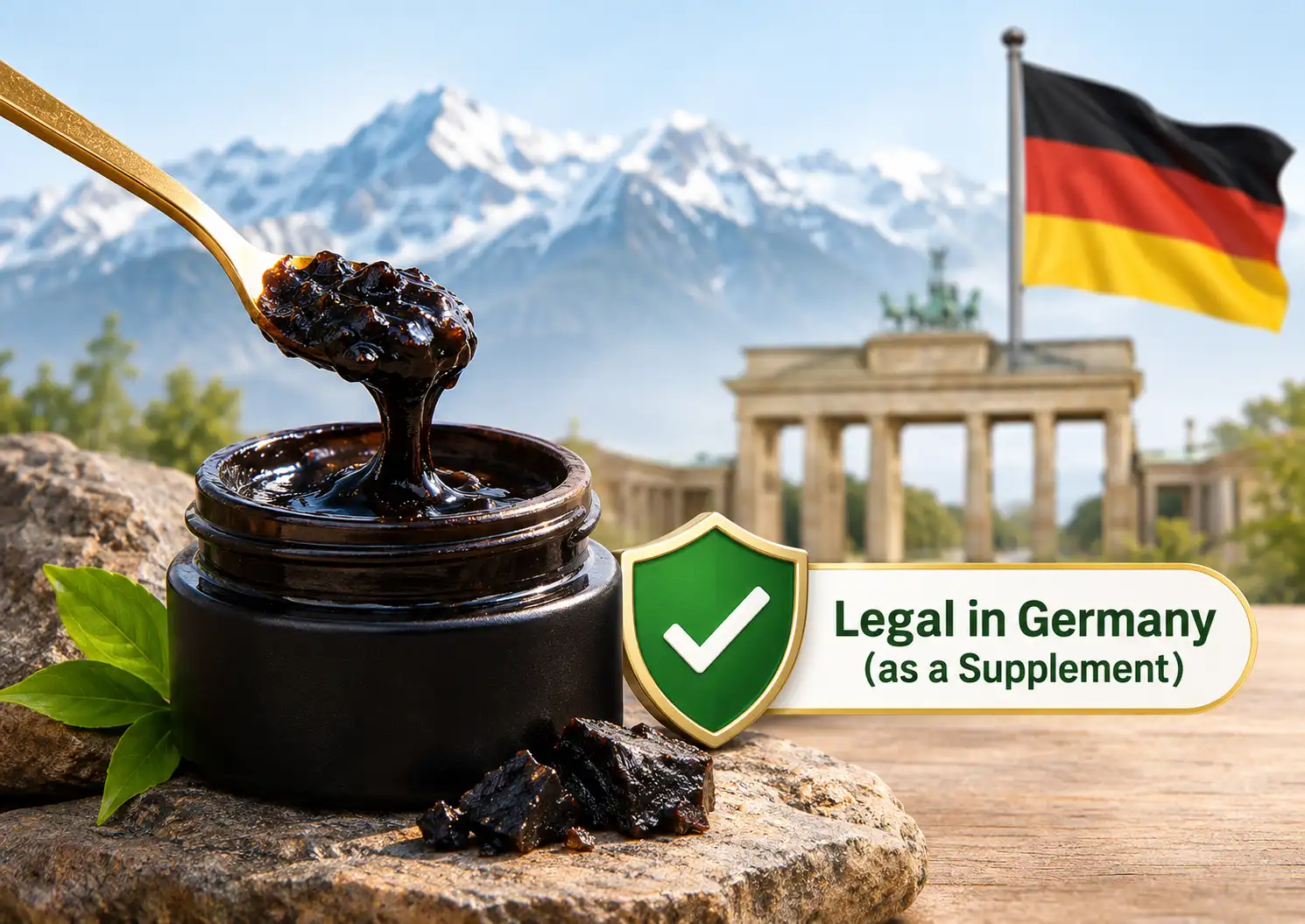
Yes, shilajit is legal in Germany, but only as a food supplement. The substance itself isn’t banned. Products get into trouble over how they’re classified and what the label promises, and then over what turns up in the lab.
That last point matters more than the headline answer. Plenty of listings say “made in Germany” and “lab tested,” and neither phrase tells you the product follows German food law. Shilajit forms in mountain ranges like the Himalaya and the Altai, so “made in Germany” describes at most the processing and packing.
Shilajit is legal in Germany as a supplement, not as a food ingredient
The European Commission’s Novel Food Status Catalogue lists mumijo, also sold as shilajit or Asphaltum punjabinum, as a novel food. The entry adds a note that it is not novel in food supplements, as a German pharmacist trade outlet explains. The Commission’s own catalogue page spells out what that kind of status means: if an ingredient was used only in supplements, any new use in other foods needs authorization.
So a capsule or a dosed portion sold as a supplement sits on firm ground. Shilajit stirred into a drink, a snack bar or a coffee blend doesn’t, because that’s a conventional food use. Online sellers who list an unauthorized novel food also risk warning letters (Abmahnungen), as a May 2025 legal overview describes.
Selling a supplement in Germany also comes with a paperwork step. Under section 5 of the supplement ordinance (NemV), the manufacturer or importer has to notify the BVL, the federal consumer protection and food safety office, before the first sale. That’s a notification, not an approval. The Verbraucherzentrale points out that the BVL’s reply is only a confirmation of receipt, not a certificate that the product may be sold. A “BVL registered” badge on a product page is weaker than it sounds.
There’s one more catch for brands that lead with fulvic acid. According to the Verbraucherzentrale, fulvic acid as an ingredient counts as novel in supplements and ordinary foods alike, it hasn’t been authorized, and the claim “rich in fulvic acids” isn’t a permitted nutrition claim. Whole shilajit and added or isolated fulvic acid are different legal questions, and a bold percentage on a label doesn’t answer either one.
Is it safe? The heavy metal question
This is where most of the real risk sits, so it gets the most space.
Since the EU contaminants regulation 2023/915, supplements have maximum levels for some metals: lead at 3.0 mg/kg, cadmium at 1.0 mg/kg and mercury at 0.1 mg/kg. Arsenic has no specific limit for supplements, only the general rule that a product must be safe, the Verbraucherzentrale notes. Keeping to those numbers is the job of the manufacturer or importer. Official food control checks products after they reach the market.
The history behind those rules isn’t comforting. State food labs in Bavaria and Lower Saxony have reported on ayurvedic supplements. One of those investigations found toxic metals in 60 percent of the samples, with arsenic up to 49,000 times above reference values. In 2022 the journal arznei-telegramm described a severe lead poisoning in a 24-year-old man in Cologne after he took an ayurvedic supplement for general wellness. Those cases involve ayurvedic products broadly, not shilajit specifically, but shilajit sits in that category.
For shilajit itself, the German pharmacist article states that natural shilajit regularly contains worrying amounts of lead and mercury, plus arsenic. It also flags thallium in individual products, in some analyses at levels above those in the raw material.
Now the data point that cuts the other way. In 2026 the CVUA Stuttgart, a state food testing lab, examined twelve shilajit products. According to the Verbraucherzentrale’s summary, it found no excessive heavy metals. It did find four products with notable mineral oil residues (MOSH), and it rated one product unsafe because of its aromatic mineral oil content (MOAH).
That result is a fair warning against two lazy conclusions. Shilajit isn’t automatically poisoned, and a clean heavy metal panel doesn’t make a product clean. The same source adds that “lab tested” guarantees little, since many tests cover only a few substance groups.
What the label can and can’t say
German food law is strict here. Advertising a supplement as preventing, treating or curing a disease is prohibited. A claim about high mineral content is allowed only if the mineral is named and the legal conditions for that claim are met. The EFSA hasn’t authorized any specific health claim for shilajit.
The science doesn’t stretch far anyway. The most cited human study gave men aged 45 to 55 purified shilajit (250 mg twice daily) for 90 days and saw a moderate testosterone rise. It was small, with no long-term follow-up and no confirmation study, according to the pharmacist review. If a product page cites it as proof of anything, treat the page with suspicion.
How to check a product before you buy
A few checks take ten minutes and screen out most of the problem listings:
- Look for a responsible company with a real EU address on the label or product page.
- Ask for the lab report of the specific batch you’d receive, not a generic certificate.
- Check that the report covers lead, cadmium, mercury and arsenic, and ask whether thallium and mineral oil were tested as well.
- Skip any product that promises to treat a condition or raise testosterone, or that sells fulvic acid percentage as a health benefit.
- Prefer products with ISO 9001 certification or the BDIH heavy metal testing seal, which the Verbraucherzentrale recommends for ayurvedic supplements. ISO 9001 covers quality management, so it doesn’t replace a lab report.
Quick answers
Can I bring shilajit home from India or Nepal?
The Verbraucherzentrale advises, as a precaution, against bringing ayurvedic products back from holidays. It also singles out private orders from abroad, including online ones, as especially problematic.
Is it safe during pregnancy, while breastfeeding or with medication?
Data are missing. The Verbraucherzentrale says long-term data for pregnant and breastfeeding women, children, chronically ill people and people with autoimmune disease don’t exist, and drug interactions can’t be ruled out. Talk to your doctor first. This article is general information, not medical or legal advice.
Is shilajit a medicine in Germany?
It can be treated as one. Ayurvedic products may be classed as either medicines or supplements, and medicines need a marketing authorization that supplements don’t, the Verbraucherzentrale explains. A supplement that advertises treating a disease breaks the advertising rules.
Before you order
Email the seller and ask for the lab report of the current batch, with heavy metal results and a line on mineral oil. If you get no answer within a few days, buy from someone who replies.
Sources
- Shilajit, ein Superfood aus dem Himalaya? (PTAheute, October 2025)
- Mumijo bei Darmproblemen? (Verbraucherzentrale, updated October 2026)
- Ayurvedische Nahrungsergänzungsmittel (Verbraucherzentrale, updated October 2026)
- Wie sind Nahrungsergänzungsmittel geregelt? (Verbraucherzentrale)
- Distribution and import of foods including food supplements (BfR)
- Novel Foods Abmahnwelle (IT-Recht Kanzlei, May 2025)
- Novel Food status Catalogue (European Commission)