 By
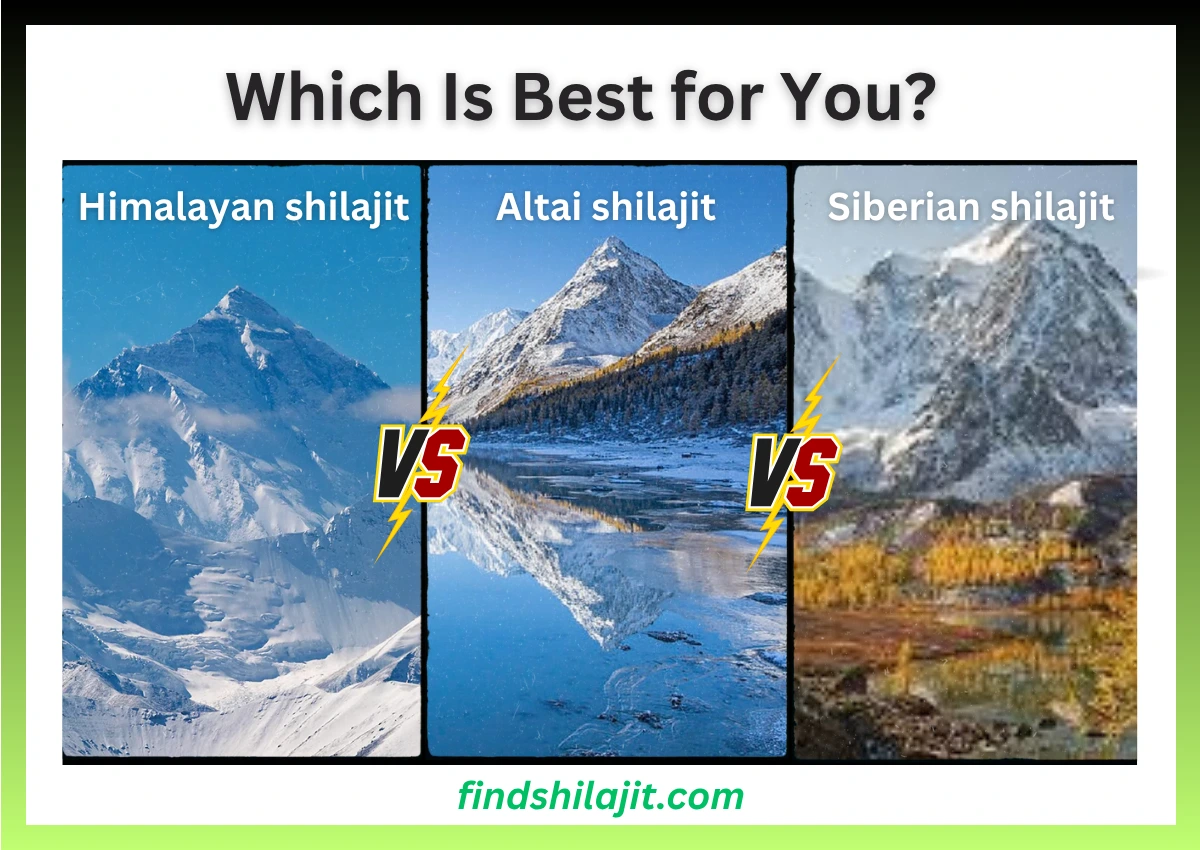
ByAre you trying to figure out which Shilajit is best for your body, like Siberian Shilajit vs Himalayan Shilajit vs Altai Shilajit? Everyone is talking about it these days.
If you’ve been looking into Shilajit for energy, strength, rejuvenation, endurance, or overall wellness, you’ve probably come across these three popular types.
While all three are natural and rich in minerals, their origin plays a major role in their purity, potency, and health benefits.
Many people get confused about which one to choose and why. In this article, we’ll clear that up by comparing Himalayan, Siberian, and pure Altai Shilajit in simple terms.
You’ll learn how they differ, which one fits your goals best, and how to avoid poor-quality options. Let’s find out which Shilajit truly stands out.
What is Shilajit & Why Its Source Matters Most
Essentially, Shilajit is a natural, blackish, tar-like resin formed over centuries from the decomposition of plants and minerals trapped in mountain rocks by temperature changes.
It oozes out during warmer seasons and is hand-collected from high-altitude regions. Rich in fulvic acid, trace minerals, and antioxidants, Shilajit is known for boosting energy, strength, and overall wellness.
But not all Shilajit is the same. Its quality depends heavily on its source. Factors like altitude, soil purity, temperature, mineral content, and even the processing method all affect its potency.
Some types, like Altai Shilajit, may show higher fulvic acid levels, often 70% to 80%, but this can be misleading. Fulvic acid is just a carrier; the real value lies in what it carries: essential minerals, trace elements, and organic compounds.
When buying Shilajit, check factors like water content, fulvic and humic acid levels, processing method, and other ingredients.
In Ayurveda, Shilajit sourced from high mountains, especially the Himalayas, is considered the most potent due to its ancient mineral richness and energetic value. That’s why the origin of Shilajit isn’t just a detail; it’s a key factor in how well it works for your body.
Himalayan Shilajit
Himalayan Shilajit is a naturally occurring resin extracted from high-altitude rocks in the Himalayan regions of India, Nepal, and Bhutan.
Scientifically, it is classified as a humic substance, composed of fulvic acid, humic acid, dibenzo-α-pyrones, amino acids, and over 80 trace minerals.
These bioactive compounds are the result of centuries-long decomposition of plant matter, combined with pressure and temperature variations unique to the Himalayan ecosystem.
What makes Himalayan Shilajit stand out is its altitude, low temperature, purity, and ancient Ayurvedic heritage.
Himalayan Shilajit is harvested at higher altitudes, above 16,000 feet, compared to Siberian Shilajit, which is found around 12,000 feet.
The extreme environment of the Himalayas produces a highly potent, mineral-rich form of raw Shilajit.
In Ayurveda, it is considered a pure Rasayana, used traditionally for enhancing vitality, stamina, mental clarity, anti-aging, and immunity.
People love Himalayan Shilajit because it is seen as the most authentic and time-tested. Its effects are well-balanced, making it ideal for daily use without overstimulation.
It’s also known for supporting testosterone levels, increasing energy naturally, and promoting faster recovery from fatigue and stress.
Advantages:
- It has high potency and mineral-rich raw shilajit.
- Deep Ayurvedic roots with thousands of years of traditional use
- Generally high purity if sourced from trusted locations
- Balanced mineral and fulvic acid profile, ideal for long-term use
Disadvantage:
- The most counterfeited type in the market due to its popularity
- It’s not easy to find pure Himalayan shilajit because many governments have banned its sourcing from the mountains.
- It is very hard to find raw shilajit in the Himalayan mountains due to the low temperature.
Siberian Shilajit
Siberian Shilajit is sourced from the Altai-Sayan mountain region in Siberia, Russia, which is why it is also called Altai Shilajit or Mumio. It is an area known for its extreme cold, dense forests, and high-altitude rock formations.
This Shilajit forms in a much colder climate compared to its Himalayan counterpart, with collection regions typically around 12,000 feet, which is lower than Himalayan Shilajit.
The freezing temperatures slow down the decomposition process, which can influence the nutritional composition, leading to slightly different levels of fulvic acid, humic acid, and trace minerals.
The major difference is that Siberian Shilajit is often darker, denser, and less sticky than Himalayan Shilajit.
Some lab tests show it contains higher fulvic acid levels (sometimes over 60%), which is appealing to some consumers. However, as experts point out, fulvic acid is just a carrier, and what truly matters is the diversity and bioavailability of the minerals it carries.
Due to different soil composition and microbial activity, Siberian Shilajit may have a slightly different mineral spectrum, but it still offers valuable benefits like enhanced energy, detox support, immune modulation, and mental clarity.
The cold, untouched environment of Siberia helps preserve the rawness and sterility of the resin, but market availability and authenticity remain challenges.
It’s less commonly used in traditional medicine systems like Ayurveda and is newer to the global wellness market. Also, the lack of long-standing cultural or medical use sometimes makes it harder for buyers to verify source credibility or proper harvesting methods.
Advantages:
- May contain higher fulvic acid percentages if sourced from a specific area
- It might be more affordable than the Himalayan shilajit
- Sourced from a clean, remote environment with less industrial contamination
- Useful for detox, stamina, and general wellness
Disadvantages:
- Not traditionally used in Ayurveda; lacks cultural or historical context and awareness
- Less regulated and often lacks transparency in sourcing or lab testing
- Some products may be overly processed or not true raw resin
Himalayan Shilajit Benefits
- Boosts Your Energy Naturally
It helps increase your stamina and reduces tiredness by improving your body’s energy production. - Improves Brain Function
Supports better memory, focus, and mental clarity by nourishing your brain cells. - Supports Hormonal Balance
Helps in increasing testosterone levels in men, supporting the strength and vitality of your body. - Builds Immunity
Rich in minerals and antioxidants that strengthen your immune system and fight infections to make you healthy. - Slows Aging
Its anti-aging properties support healthier skin, better strength, and longer vitality, and make you feel younger.
Altai Shilajit Benefits
- Detoxifies the Body
Helps remove harmful toxins and heavy metals from your system, thanks to its fulvic acid content, which helps with weight loss. - Boosts Physical Strength
Increases muscle strength and stamina, making it useful for athletes and fitness lovers. - Improves Mineral Absorption
Balances trace minerals in your body, helping improve digestion, bone health, and cell repair. - Supports Better Focus and Mood
It may help reduce stress and improve mental focus by balancing neurotransmitters. - Comes from a Clean Source
Sourced from the Altai Mountains, it is often free from industrial pollution and heavy chemicals.
Full Comparison: Himalayan vs. Siberian vs. Altai Shilajit
| Factor | Himalayan Shilajit | Siberian Shilajit | Altai Shilajit |
| Origin | India, Nepal, Bhutan | Russia (Altai-Sayan Mountains) | Central Asia (Altai region) |
| Altitude | High (Above 16,000 ft) | Medium (~12,000 ft) | Medium (~10,000 ft) |
| Traditional Use | Deep roots in Ayurveda | Russian folk, some TCM | Emerging/Folk medicine |
| Fulvic Acid Content | High (up to 75%) | Moderate to High (50–60%) | Moderate (~50%) |
| Mineral Content | 80+ trace minerals | High fulvic acid focus | Balanced fulvic and humic profile |
| Color & Texture | Dark brown to black, sticky resin | Slightly lighter, semi-hard | Sticky, thick, black |
| Availability | High (but often counterfeited) | Moderate | Limited, small-batch |
| Purity (if legit) | Excellent (low heavy metals) | Good, but varies | Very good, if properly sourced |
| Detox Potential | Excellent—ideal for cellular detox | Good—high fulvic acid helps | Moderate—balanced detox support |
| Heavy Metal Content | Lead: 0.05 mg/kg Arsenic: 0.13 mg/kg Cadmium: <0.02 mg/kg Mercury: <0.01 mg/kg | Lead: 0.8 mg/kg Arsenic: 0.7 mg/kg Cadmium: 0.2 mg/kg Mercury: 0.005 mg/kg | Limited lab data, but generally low levels |
| Price Range | Mid to High | Low to Mid | Mid |
| Best For | Authentic, balanced, long-term wellness use | Energy boost, detox, modern supplementation | Clean sourcing, mineral balance, and modern users |
| Main Concern | The market is flooded with fakes | Limited traditional backing, quality varies | Harder to verify, lower availability |
Why fulvic acid percentages don’t mean what they seem
Two brands can list very different fulvic acid numbers on the same type of Shilajit, and neither has to be lying. The number depends on which test produced it.
Older colorimetric testing methods tend to read lower. The modern spectrophotometric method, the one most accredited third-party labs use now, reads higher because it captures a fuller extractable fraction. So a Siberian product tested at 55% and a Himalayan product tested at 75% might reflect two different assay methods, not two different resins.
A high percentage with no method listed on the certificate tells you less than a lower percentage from a lab that names its method. Fulvic acid content also isn’t the same thing as fulvic acid bioavailability. A resin can test high and still absorb poorly depending on how it was processed.
Before comparing percentages across brands or origins, check which assay method each one used. If a brand can’t say, the number on the label is closer to marketing than measurement.
How to Choose the Right Shilajit
- Look for Lab-Tested Certification
This is very important; always choose Shilajit that comes with third-party lab reports to confirm purity, safety, and active compound levels. - Know Your Health Goal
- Energy & stamina: Go for fulvic-rich varieties like Himalayan or Siberian.
- Detox & cellular health: Himalayan Shilajit is ideal due to its low heavy metal content.
- Hormone & testosterone boost: Prioritize traditionally used Himalayan Shilajit.
- Check for Testing and Formulation Methods.
- Check Brand Reputation & Transparency
Trusted brands clearly show sourcing location and lab reports and do not hide ingredient details. Check for the sourcing of raw shilajit. - Understand the Source Region
- Himalayan: Traditional, balanced, Ayurvedic support
- Siberian: Modern detox and energy support
- Altai: Clean, emerging, mineral-rich variety
How to actually read a Shilajit lab report
Most people stop at “does this brand say lab-tested.” That’s not enough. Here’s what to check on the actual certificate of analysis (COA) before you trust it.
Full panel, not partial. A real safety test covers lead, arsenic, mercury, and cadmium. Some cheaper brands test only for lead and call the product “heavy metal tested,” which is technically true and still misleading.
Named, accredited lab. Look for an ISO 17025 accredited third-party lab. Eurofins is a common one in this space. An in-house lab or an unnamed one carries far less weight, since there’s no outside check on the result.
Fulvic acid method disclosed. A trustworthy COA names the assay method next to the fulvic acid percentage. If the method isn’t listed, you have no way to know what that number is actually measuring.
Batch number and test date. A COA should match the batch you’re holding, not a single old report reused across every batch a brand has ever sold. If the batch number on your jar doesn’t match the COA, the document is decorative.
Myth vs. reality: what origin actually changes
| Myth | Reality |
| Himalayan Shilajit is always more potent | Origin affects mineral and phenolic-acid profile, but potency within any single origin depends far more on purification quality and freshness than on the mountain range |
| Siberian or Altai Shilajit is automatically cleaner because it’s less commercialized | Contamination risk comes from purification and testing practices, not from how well-known the source is |
| Higher altitude always means purer resin | Altitude reduces some contamination exposure, but heavy metals already in the local rock don’t disappear just because the harvest site is higher |
| Raw, unprocessed Shilajit is more authentic | Raw resin is also unpurified. It still carries whatever was in the surrounding rock. Raw isn’t the same as safe |
| You can tell real Shilajit from fake by how dark or sticky it is | Texture and color shift with processing and storage temperature as much as with origin. They can’t confirm authenticity on their own |
Top Brands by Origin and Reviews by User
Himalayan Shilajit:
Kapiva is one of the most trusted and in-demand Shilajit brands in India, offering a variety of Shilajit products. It also has positive reviews on Amazon, as shown in the screenshot below for your reference.

Pure Himalayan Shilajit is a globally trusted brand known for delivering premium-grade Shilajit resin, ethically harvested from the Himalayan Mountains at altitudes of over 16,000 feet. It also has good reviews on Amazon.

Siberian Shilajit:
Altair is a USA-based health and wellness brand that offers its products on Amazon. Here are a few Altai Mountain shilajit reviews from Amazon for your reference.

When Himalayan isn’t the right choice
Himalayan Shilajit gets treated as the default best option, but that’s not true in every situation.
On a tight budget. A cheap, unverified “premium Himalayan” product is a worse bet than a well-tested Siberian or Altai product from a transparent brand. Purification and lab verification matter more than the name of the mountain.
Worried about counterfeits. Himalayan Shilajit is the most faked type on the market precisely because of its reputation. If you’re buying somewhere with limited access to verified Himalayan suppliers, a smaller, more traceable Altai brand can carry less fake-product risk.
Sensitive to strong mineral taste or stomach discomfort. Some people find Siberian or Altai resin milder. That’s a smaller factor than purity, but it affects whether you’ll actually keep taking it.
Prioritizing detox-support framing. Altai brands lean harder into fulvic-acid-driven detox claims in their marketing. The underlying evidence for this being origin-specific rather than dose-specific is thin, so treat this as a marketing emphasis, not a proven advantage.
Following traditional Ayurvedic dosing and rasayana use specifically. Here, Himalayan is the right call. It’s the only origin with real depth of traditional-use documentation, which matters if that context is part of why you’re taking it.
Conclusion
Choosing between Himalayan Shilajit, Siberian Shilajit, and Altai Shilajit depends on what your body needs and what kind of product you trust. I have tried to explain all the things you need to know.
If you want something with a strong history in Ayurveda and for long-term health, Himalayan Shilajit is a great option for you.
If you are looking for more energy or want to clean toxins from your body, then Siberian or Altai Shilajit can be a better choice, especially if it’s pure and comes from the Altai Mountains.
Each type—Shilajit Altai, Himalayan, or Siberian—has its good points. So, before buying, check if the brand is trusted, if the product is tested in a lab, and if it fits your health goals.
In short, don’t just go with what’s popular. Read reviews, understand the Altai Shilajit benefits, and make sure it’s real and safe. A little research can help you choose the best Shilajit for your health.
FAQ
What is the main difference between Altai and Himalayan shilajit?
Altai Shilajit comes from the Altai Mountains in Russia, while Himalayan Shilajit is sourced from the Himalayas of India, Nepal, and Bhutan.
Is Altai Shilajit safe to use?
Yes, but only when it’s pure Altai Shilajit from trusted sources. Always check for lab-test certificates, and avoid overly processed or powder-based products.
How can I check if the Shilajit is pure or fake?
Real Shilajit is sticky, dark, and tar-like. Always choose products with third-party lab reports, clear origin info, and no added chemicals. Also, check for raw shilajit sourcing.
Can I take Himalayan or Altai Shilajit together?
Yes, but in small doses. Make sure the Shilajit is lab-tested and free from heavy metals. If you’re new to it, consult a health expert first.
Why is Himalayan Shilajit stickier and darker than Altai Shilajit?
Because Himalayan Shilajit comes from higher, colder mountains, it forms more slowly and becomes thicker and darker. Altai Shilajit comes from lower, slightly warmer areas, so it’s usually smoother and less sticky.
Which is more expensive, Himalayan or Altai Shilajit?
Himalayan Shilajit is usually more expensive due to high demand and tough sourcing. Altai Shilajit is generally cheaper but still good if it’s pure and lab-tested.
Disclaimer
This article is for informational purposes only. Please consult a licensed healthcare provider before starting any new supplement, especially if you are pregnant, breastfeeding, or on medication.
Also Read:
Shilajit Gummies vs Shilajit Energy Drink – Which One Is Right for You?
Shilajit Resin vs Powder vs Capsules vs Gummies – What’s Right for You?
References:
- Plant-derived phenolic acids in Shilajit: a comparative HPLC-MS/MS analysis across five regions — Scientific Reports, 2026. The most directly relevant study to this exact article: a chemical comparison of shilajit from Iran, India, Nepal, Russia, and Kyrgyzstan that found real, measurable geographic variation in composition, confirming that origin genuinely changes the resin’s chemistry.
- A Comprehensive Review on Shilajit: What We Know about Its Chemical Composition — Critical Reviews in Analytical Chemistry, 2023. A broad review of shilajit’s fulvic acid, humic substances, and mineral content, useful for backing up composition claims with something more rigorous than brand marketing copy.
- Systematic Review of Shilajit: Clinical Efficacy and Safety — Journal of Population Therapeutics and Clinical Pharmacology, 2024. Covers 15 clinical trials and 1,254 participants, useful for an honest safety-and-efficacy citation rather than an unsupported benefits list.
- Lead, Mercury, and Arsenic in US- and Indian-Manufactured Ayurvedic Medicines Sold via the Internet — JAMA, 2008. The core study behind most heavy-metal-in-Ayurvedic-products concerns. Good citation for the risk side of the piece instead of the unsupported numbers table.
- Heavy Metal Profile of Shilajit Samples Obtained from Gilgit and Chellas, Pakistan — A regional heavy-metal testing study specific to Himalayan-region shilajit, useful if you want a real (if limited) origin-specific data point instead of the fabricated table.
- Pre-clinical Evaluation of Shilajit in Cancer: A Systematic Review — Cureus, 2026. Useful for showing you’re citing current, active research rather than only older studies, and it’s honest about the evidence being preclinical, not a human-trial claim.
- Shilajit: A Natural Phytocomplex with Potential Procognitive Activity — International Journal of Alzheimer’s Disease, 2012. A frequently cited foundational review on fulvic acid’s neuroprotective mechanisms, useful if the article touches on cognitive-benefit claims anywhere.
- Clinical studies and safety evidence for human consumption of Shilajit — International Journal of Basic & Clinical Pharmacology, 2025. A recent, specifically

Reviewed by: Dr. Natha Thomas, PhD (USA)
Nutrition and supplement research professional interested in nutritional science, dietary supplements, nutrient bioavailability, scientific literature, and how research findings are communicated to consumers.
View full profile →Medical review date: July 28, 2025